World War 1 & 2

t-ww820WW 820

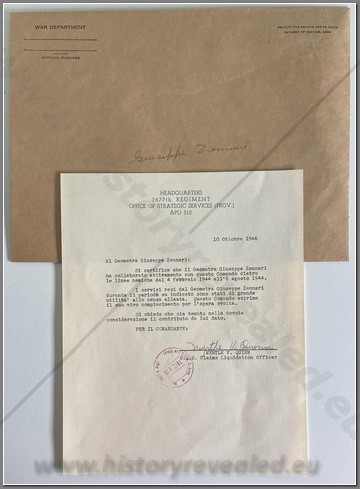
Letter from the 2677th regimental HQ date October 10, 1946. It is a letter of commendation for Giuseppe Zennari stating that he actively collaborated with his Command behind enemy lines from 4 February 1944 to 8 August 1944. It states “The services rendered by Surveyor Diuseppe Zennari during the above-mentioned period was of great benefit to the Allied cause. This Command expresses it deepest satisfaction with the work accomplished. It is requested that his contribution be given due consideration.”

Price: $60.00

t-ww817WW 817

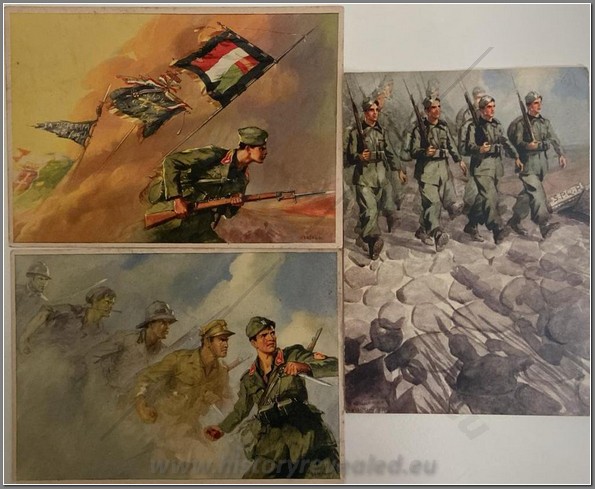
3 patriotic postcards for the G.I.L. AH

Price: $300.00

Note: The Gioventù Italiana del Littorio (GIL) (Italian Youth of the Lictor) was the consolidated youth movement of the National Fascist Party of Italy that was established in 1937, to replace the Opera Nazionale Balilla (ONB). It was created to supervise and influence the minds of all youths, which was effectively directed against the influence of the Catholic Church on youths. The organization surpassed its purpose as a cultural institution that was intended to serve as the ideological counterpart of school, and served as a paramilitary group (training for future assignments in the Italian Army), as well as education in the career of choice, technology (including postschool courses for legal adults), or education related to home and family (solely for the girls). It carried out indoctrination with a message of Italian-ness and Fascism, training youths as "the fascists of tomorrow". Moreover, the GIL took charge of all activities initiated by schools, and pressured teachers to enlist all students. Aside from the usual "Fascist Saturdays", children would spend their summers in camps (which included the national-level Campi Dux, reunions of Balilla and Avanguardisti). Male children enrolled wore a uniform adapted from that of the Blackshirts: the eponymous black shirt, the fez of Arditi tradition, grey-green trousers, black fasces emblems, and azure handkerchiefs (i.e.: in the national colour of Italy). During military exercises, they were armed with scaled-down version of Royal Italian Army service rifle, Moschetto Balilla (the rifles were replaced with replica versions for the Figli della Lupa).

When Italy entered World War II, members of the GIL who were above the age of eighteen were called up to fight in the Royal Army of Italy but in 1943 after a string of defeats in The Eastern Front, Operation Torch and the Invasion of Sicily. Boys who were sixteen and over were called up to fight until the Armistice of Cassibile was signed. However, boys and girls of the GIL found themselves picking sides. Some served in the Italian Co-Belligerent Army, the National Republican Army or the Italian Resistance Movement after German troop marched into Italy and disarmed Italian troops, who refused to continue fighting and established the Italian Socialist Republic.

t-ww816WW 816

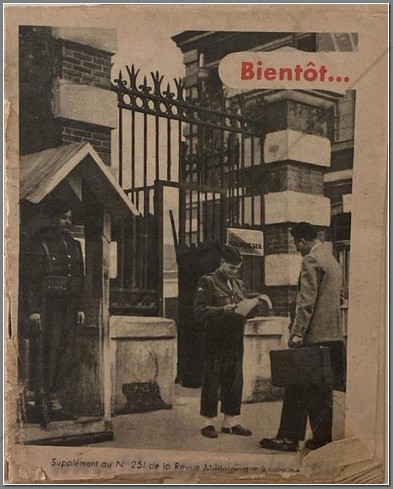
Booklet for new recruits to the French army immediately following WW2, published as a supplement to the Revue Militaire d’Information. It tells them what to take with them, answers the question of what is the point of military service, explaining that since 1870 military service is compulsory, military service is not always fun, you have to submit to discipline, you will feel isolated, you wont always feel you are doing something useful, but you wont waste your time. You will understand the meaning of “Esprit de Corps”, you will make friends from all different professions, you will make strong friends, we will assist you, you may be called up to a Branch or Service, you may be stationed outside France (North Africa, Germany or Austria), you will learn to use your weapons, do sports, learn the basics of a trade, you can join a platoon and become an NCO and learn to command, wear insignia, you will wear a uniform and learn that your attire is a reflection of the army, and the efforts required of you and the difficulties you encounter will contribute to the formation of the man you will become. Be a good soldier and you will help give France a strong army, a guarantee of peace for your country, of security for your work and for your family.

Price: $60.00

t-ww815WW 815

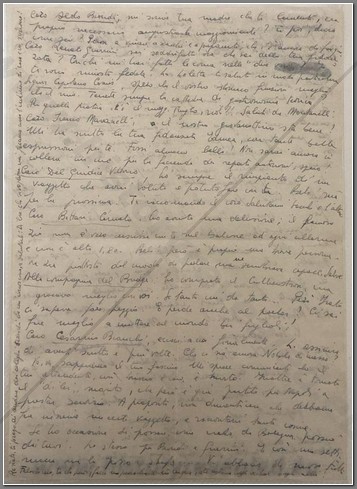
Letter from a senior Italian officer named Gerardo Marchitelli written April 7, 1946. He is writing to several men, so they are likely all within the same unit. He writes of his time fighting in Yugoslavia and his time as a POW in Italy He writes:

Dear Edo Bianchi, your mother writes to me that you are constantly asking whether I need anything else. I thank you like a son. It is beautiful to see how you have grown—so active, so prepared, and so devoted to your studies.

Dear Renzo Benini, you are satisfied now that you have chosen that path? You were truly strong in holding your ground as you did. Your number plate is the fourth Cavalry Regiment, not the first—Captain Comini said so. I hope that your physical condition is improving. Keep going on this path of constant discipline. In those moments, it is the body that must respond.

Dear Franco Manzelli, your good mood is evident. I have received your kind letter, full of affection for me. You truly are beautiful in spirit. We will still see one another in another role—perhaps in the autumn departments, who knows?

Dear Judge Vittorio, I always carry regret for a project that I would have liked to bring forward with you—for the future. I warmly recommend Edo. Please give my greetings to your family.

Dear Bottari Carmelo, I have written to you many times. Franco tells me it is true that you are enrolled at the Salerno school and that you are doing well. Good. But you must always have a firm grip. You must speak to the world with sincerity, especially now in the rebuilding of the Bridge. I have taken on the Culbertson system; it gives me great satisfaction. I do it with great care. I feel that we are slowly making progress. Words also help—but there are moments when it is better to act than to speak.

Dear Cesare Bianchi, here we are finally. You have been silent for a long time—why? Come on, let us clear the fog. I would like to know everything about your activity, your work, your heart, and everything. Giulietta is well; her husband, however, left for Naples to take up his position. Regarding me: my life is made up of projects and stories, just as before. I have the opportunity to speak with people from Brescia, from Bologna, from Turin. I stay in touch with everyone. I remain firm in my plans and future. I embrace you strongly.

Dear Captain Zanda, 7 April 1946, I address myself to you because I believe that, among all, you are the one who best understands what I mean when I speak of certain matters. When one closes a chapter of life, one must be able to understand its meaning, even if it was painful. I believe it would be foolish to deny the reasons that led us to certain decisions. People who know how to stand on their own feet are always better than those who depend on others. We can make mistakes, yes, but we can also correct them with awareness. What we experienced in Algeria taught us much. There were manifestations, slogans, chants, and flags, but underneath it all lay something deeper: a human suffering that could not be ignored. Coming back from Yugoslavia and from that land, one understands how fragile the human person is, and how little is needed to destroy or to save. I believe that strength and precision are still necessary today. I have never believed in empty rhetoric. Even the republic, the faith, and the various ideals that have passed through history must be measured by facts, not words. In Algeria we saw many things that cannot be forgotten, and among them the awareness that certain men, once they fall, leave a mark on the people. In these years we have lost many, and with them a part of ourselves. I think of the friends: Amicielli, Giordani, Graziani, Vito Morandi, Savick, and Mussolini. I have always remained silent and have always prayed for them. What can one say, where do mistakes lie, and what is really worth saving, even from our own past? These are questions that deserve honesty, not slogans. I remain firm in my position, even if misunderstood. I await developments. Please also convey my greetings to: Bazzini, Martelli, Seldi, Raga, Tognazzi, Tomati, Fideli, Bertolotti, De Blasio, Fesi, Boatto, Nicola, Ugo, Ugo e famiglia, Puglisi, Frigerio, Panceri, Marino, Accorto, Malachini, Barbato. With esteem, Gerardo.

He writes of his time fighting in Yugoslavia and his time as a POW in Italy

Price: $90.00

t-ww814WW 814

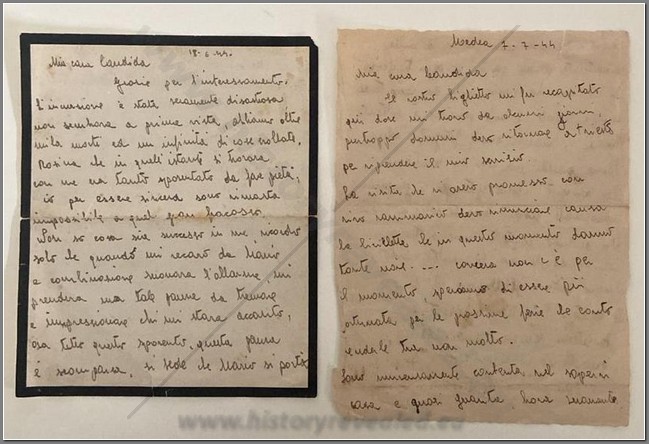
Two letters written by a woman named Luisa living in Rimini, Italy and then fleeing north to Medea during intense bombardment leading up to the Battle of Rimini in September 1944. It is missing the second page. The first, dated June 18, 1944, reads: My dear beloved. Thank you for your interest. The bombing was truly disastrous. Not only were many lives lost, but an infinite number of things were destroyed. Rimini, in those moments, appeared to me as if struck by many lightning bolts from Pietà; and to be sincere, I felt seized by an impossible dread—I don’t know what to call it. Even now, if I think back on that memory, only how much I was worried about Mario comes to mind, and when the alarm sounded again, I felt such fear and terror and the impression that you were beside me. Now all these apparitions have faded, this fear has disappeared, and God willing, Mario will return soon. One feels that little bit of interest that one has for life. Thus it is with us: it seems we have passed beyond, as if on the other side of a dream that has vanished. Days, hours, and certain moments have existed like a distant dream, full of hardships, sacrifices, and painful efforts. No one can truly understand it; only we ourselves know the tremendous struggle of this being constantly sustained solely by our affection. I always dream of him; even at night I dream of him, but it is a dream so intense that it has awakened me. The photograph I carry with me was given to me in ’41, then when he was called up to the hospital in Desenzano. I keep it always as a prayer to hold onto, and I…

She becomes a refugee and moves to Medea, further north. From there she writes on July 7, 1944, my dear beloved, the high cost was not capable of giving me strength or serenity; rather, it plunged me into a storm of events, desires, and hopes, all of which depend on my health. The visit I am about to make will reveal to me the minimal cause of the limits of these moments that have become so… empty. I realize it, and yet the moment seems to be more favorable for the coming holidays than for the account of what has been. I am immensely content in knowing you are at home and almost sure that now you are sleeping. Now you see, it was not possible for me, suddenly struck by such bitter events, to have anything of my own to tell, always equal to my thoughts and desires. Maria, I am sending you these photographs alone, because when I am not near you, they represent me well. They are certain that they express truthfully what I am like. And when will you decide to return? Compensated by now for the many sacrifices, having obtained the allowance with which the necessities of life are met. Then Maria awaits us. Preserve always and remember everything that reminds you of me. A most affectionate embrace, Luisa.

Price: $150.00

NOTE FROM WIKIPEDIA: Before the Battle of Rimini, Rimini had suffered sustained Allied aerial bombardment since November 1943. Many refugees from northern Italy had fled to Rimini between November 1942 and February 1943, only to flee again with the bombings. Of 40,000 inhabitants, only 3,000 remained, and the city centre was deserted. Around 55,000 refugees fled to the north, to the hinterland, and to the independent Republic of San Marino, where they sheltered in the country's railway tunnels. As the Allied frontline approached the city, naval bombardment followed, and remaining citizens hid in makeshift shelters or in the caves by the Covignano hill. Partisan resistance was also notable in Rimini, with official reports of 400 young people involved in resistance cells. On 16 August 1944, three partisans were hanged in Rimini's central square, which would later be renamed in their honour. Between November 1943 and September 1944, the total number of air, naval, and land bombings in the city numbered 396, destroying 82% of all buildings, the highest figure among Italian cities with over 50,000 inhabitants.

t-ww813WW 813


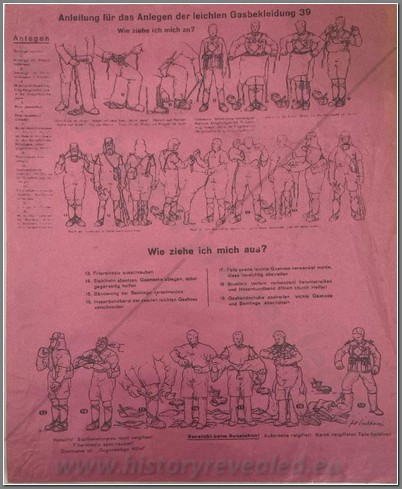
German Instructions for Putting on the Light Gas Protective Clothing 39.

Price: $90.00

t-ww812WW 812t-ww812aWW 812


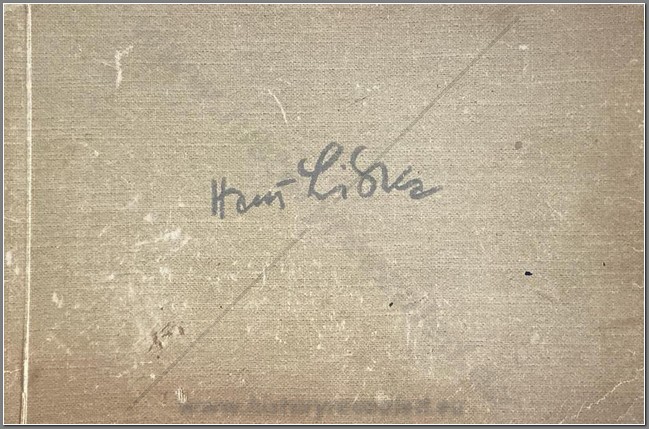
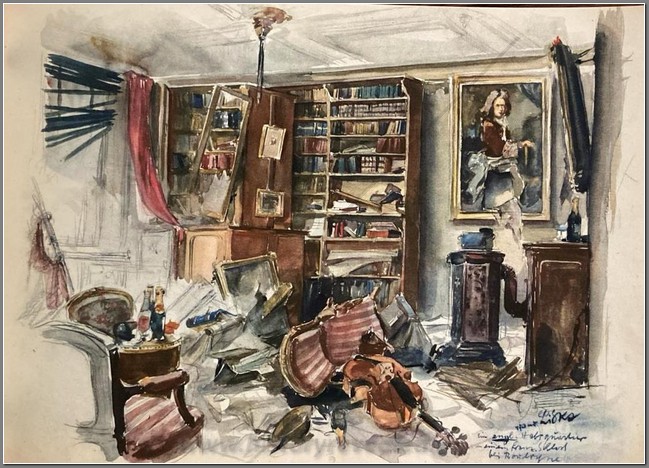
35 pages of illustrated artwork by Hans Liska (1907-1983). Reichenbach : Carl Werner, 1943. PH YN

Price: $400.00

t-ww811WW 811


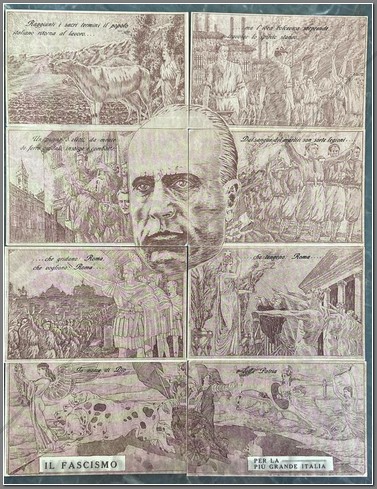
Complete 8-piece puzzle postcard set of Mussolini titled IL FASCISMO, produced on the tenth anniversary of Mussolini ascension to power. Very rare.

Price: $800.00

t-ww810WW 810


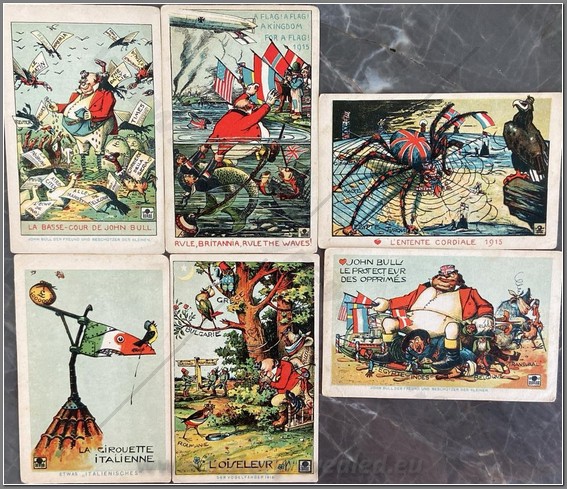
6 German propaganda postcards produced in 1915.

Price: $380.00

t-ww808WW 808t-ww808aWW 808

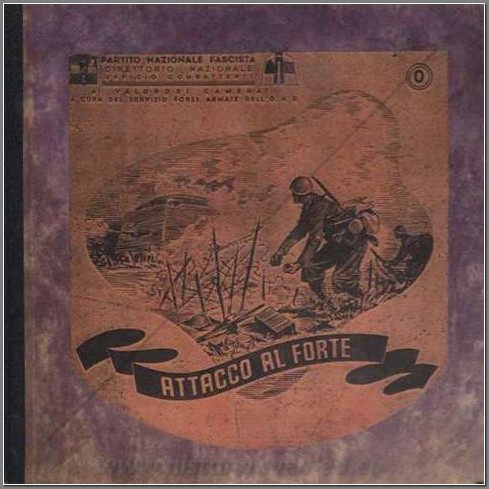
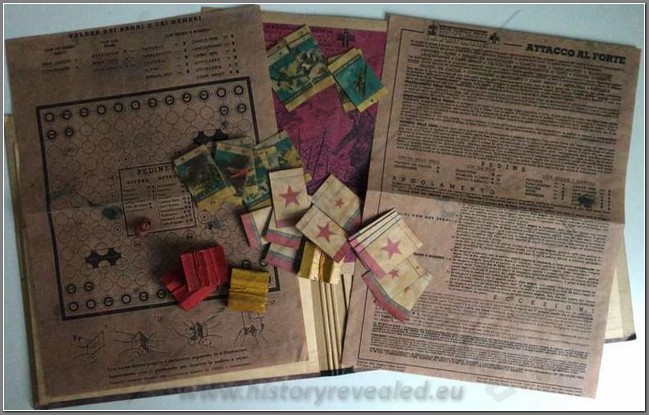
Interesting childrens game made in Germany for the Italian Fascist Party. Titled Sturm auf Das Fort. It glorifies our “German comrades”. The game pieces are original, but the game itself, instructions, and cover bag are facsimiles. It is otherwise complete with a functional  enclosure. It is completely in the German language and with German military objects but done under the auspices of the Italian National Fascist Party. Produced in 1941. AH

Price: $200.00

t-ww807WW 807


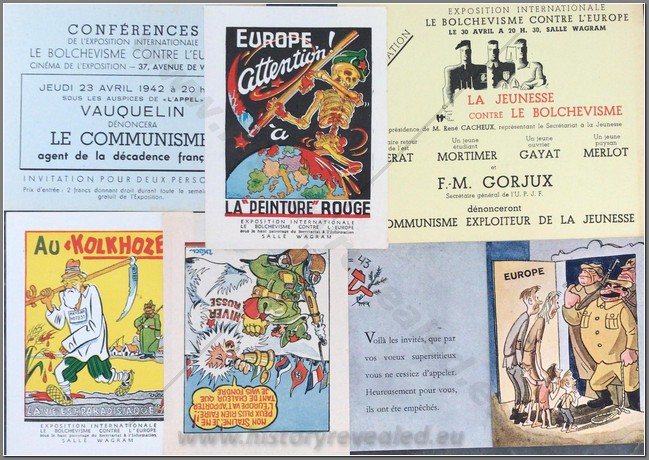
Invitations ad free give-aways for anti-communist conferences held in Paris on April 23 and30, 1942. Three of the give-aways are gum-backed stickers.

Price: $400.00

t-ww806WW 806

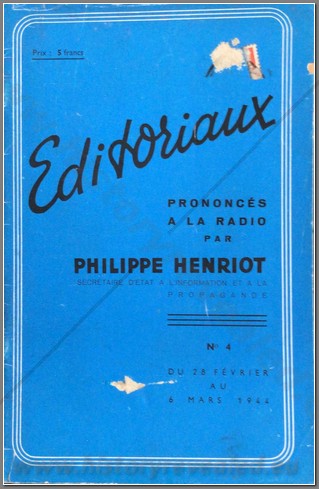
Editoriaux. Prononces a la Radio par Philippe Henroiot. Issues #1-11. It spans the period February 7 to May 8, 1944. Most likely there are only 2 or 3 others in this series as he was assassinated on June 28.

Price: $900.00

NOTE: Philippe Henriot (7 January 1889 – 28 June 1944) was a French poet, journalist, politician, and Nazi collaborator who served as Secretary of State for Information and Propaganda for Vichy France. He was also a member of the Chamber of Deputies from 1932 to 1942, representing Gironde. Henriot was known for his influential speeches in support of collaborationism, which eventually led to his 1944 assassination by the French Resistance.

In 1940, after France's surrender to Nazi Germany, Henriot became active as a journalist working for the French government headed by Philippe Pétain which had moved to Vichy. In December 1943 he was appointed Secretary of State for Information. During his career he created programmes and broadcast through Radio Paris, becoming the government's spokesman. He developed a war of propaganda against the Free French Forces and the BBC, whose spokesmen were Pierre Dac and Maurice Schumann.

Seeking to shape the perceptions of the French government and German occupation, and to destroy popular support for the French Resistance, Henriot was given the nickname of the "French Goebbels". He broadcast twice daily on Radio-Vichy, "repeatedly and eloquently attacking all those he considered lukewarm in their attitude to collaboration and calling on all good Catholics to support the German cause in the fight against communism." He continued the propaganda programmes after the Germans decided, due to the new Allied presence in North Africa, to extend their military occupation in 1942 over Southern France, formerly the Free Zone controlled by the French government at Vichy. Henriot warned the French people about any association with the Allies or "terrorists" (resistance groups) and countered the arguments of the Free French Forces broadcasting from the BBC. He wrote and delivered 270 broadcasts on Radio Vichy in a "mesmerising rhetoric and delivery" ... as a "huge media star", according to one source. "There is no doubt Henriot's broadcasts were influential, attracting a large and diverse audience."

It was said that "Henriot is listened to by everyone, enemies or supporters. Families shift their mealtimes so as not to miss him. There is no-one left in the street at the time he speaks." On 6 January 1944, Henriot was appointed as the French Minister of Information and Propaganda. In 1943, Henriot joined the Milice paramilitary "with a deep-seated conviction that Christian civilisation was engaged in a life and death struggle against Bolshevism."

Henriot was a natural target for the French Resistance, and on 28 June 1944, in the Ministry building where he lived, he was assassinated by a group of COMAC members of the Maquis, an organisation designated by the Vichy government as "terrorists". Disguised as members of the Milice, they had persuaded him to open his door. In retaliation, the Milice murdered Georges Mandel, a strong opponent of collaboration and others. Henriot was afforded a state funeral in Paris, presided over by Cardinal Suhard in Notre Dame Cathedral. His coffin was placed, surrounded by French flags and flowers, in front of the Hôtel de Ville, where thousands filed past to mourn him – less than two months before the Liberation of Paris.

t-ww805WW 805

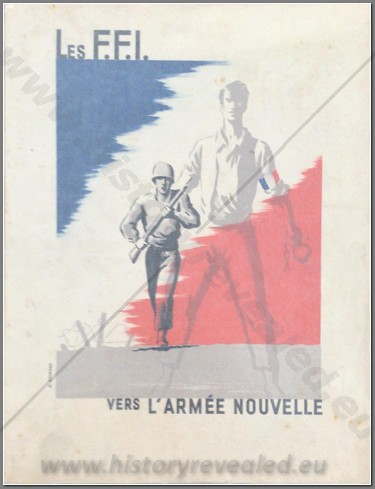
Les F.F.I. Vers L’Armee Nouvelle. Only two US universities hold this.

Price: $150.00

NOTE: The French Forces of the Interior (FFI) were French resistance fighters in the later stages of WW2. Charles de Gaulle used it as a formal name for the resistance fighters. The change in designation of these groups to FFI occurred as France's status changed from that of an occupied nation to one of a nation being liberated by the Allied armies. As regions of France were liberated, the FFI were more formally organized into light infantry units and served as a valuable manpower addition to regular Free French forces. In this role, the FFI units manned less active areas of the front lines, allowing regular French army units to practice economy of force measures and mass their troops in decisive areas of the front. Finally, from October 1944 and with the greater part of France liberated, the FFI units were amalgamated into the French regular forces continuing the fight on the Western Front, thus ending the era of the French irregulars in World War II.

t-ww804WW 804


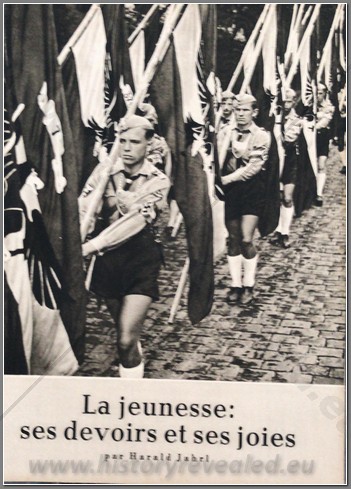
La Jeunesse: ses devoirs et ses joies, by Harald Jahrl. Only 3 US libraries hold this.

Price: $150.00

t-ww803WW 803

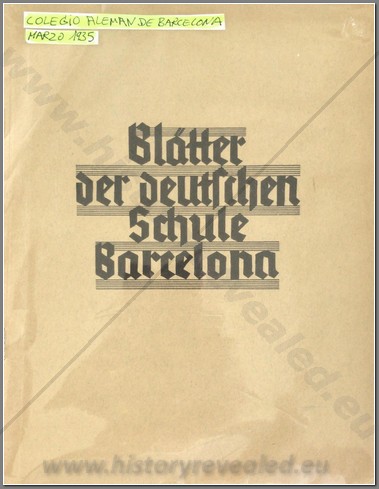
Yearbook from the German College of Barcelona, dated March 1935, shortly before the school was shutdown due to the civil war. 13 pages, it covers the activities of the school that year. As of March 14, there were 826 students attending. The inside cover translates as “German winter aid: think of your starving brothers in Germany”.

Price: $400.00

Note: The German School Barcelona is a German school abroad in the Spanish town of Esplugues de Llobregat , a suburb of Barcelona . It was founded in 1894 by Otto Amtsberg, the pastor of the local Protestant congregation. In 1912, the school was classified as a Realschule ( secondary school) by the German school authorities. A second extension was built that same year due to the increase in student numbers to 363. A third addition was added in 1928 to accommodate the now 600 students.

From 1936 to 1939, the school was evacuated during the Spanish Civil War ; the students were housed in Germany at the Otto Kühne School and the girls at the Bodelschwingh Gymnasium Herchen .

In 1941, 1,000 students attended the German School. This time, even the church building had to be demolished for the fourth extension. On June 5, 1945, the school was closed under pressure from the Allies , with whom Spain had committed itself to cooperation in 1945 under the London Declaration.

t-ww802WW 802


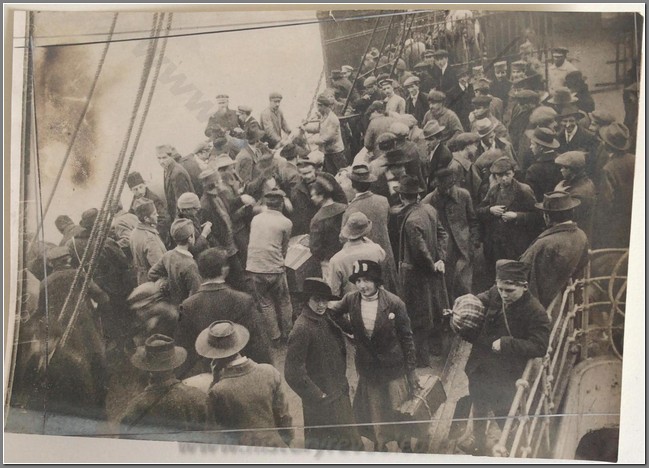
British press photo of Serbian refugees arriving at a French port.

Price: $30.00

t-ww801WW 801


2 postcards of the German surrender in WW1. Stamped Clairiere de L’Armistice – Compiegne.

Price: $60.00

t-ww800WW 800


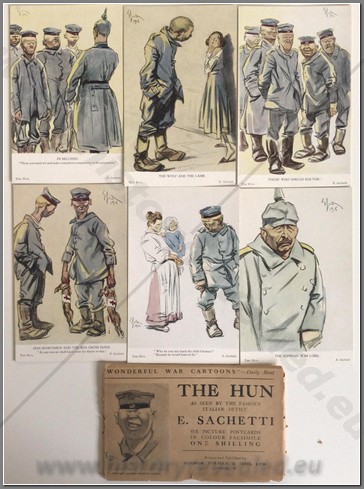
Complete set of 6 WW1 humor cards “The Hun”.

Price: $260.00

t-ww798WW 798


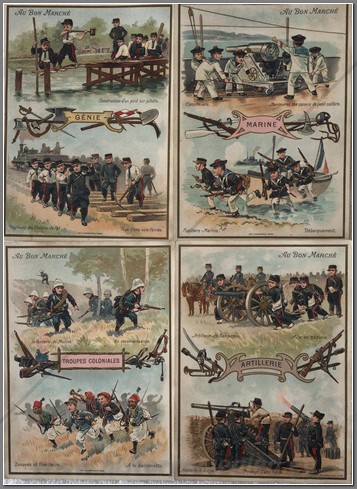
Set of 4 early advert cards by Au Bon Marche on the French military, featuring children.

Price: $200.00

t-ww797WW 797

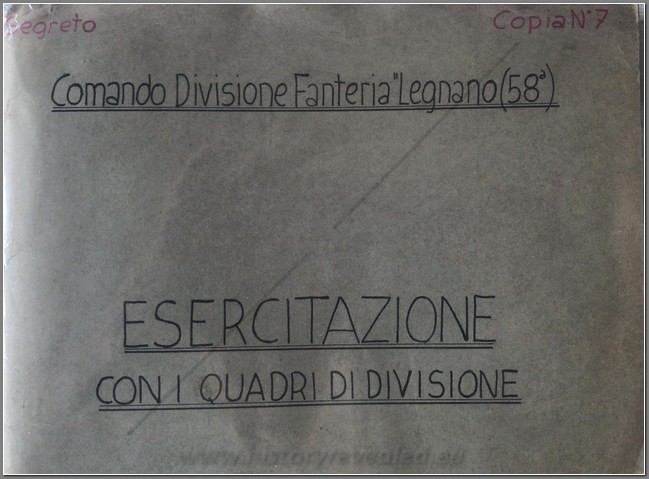
Dosier of military strategy related to the upcoming Italian invasion of Yugoslavia. Titled “exercise with division tables”, it lays out the difficulties entailed with the planned invasion. Also, in the dosier are maps reflecting the invasion of Romania in 1916 and the area around Svistov on the Danube. Also included is pasted images of specific mountains in Ethiopia, no doubt to help in understanding the terrain the Italian will be up against in Yugoslavia. Also, a 1914 painted portrait of Captain Fritz Watzeck, the dosier’s owner. The dosier is dated 29 Marzo-5 April 1940, MORE THAN TWO MONTHS BEFORE ITALY ENTERED THE WAR. It is copy number 7 and marked SEGRETO. A rare find.

Price: $500.00

Copyright © 2013-2024 History Revealed