Prints and Ephemera

t-trpe109TRPE 109


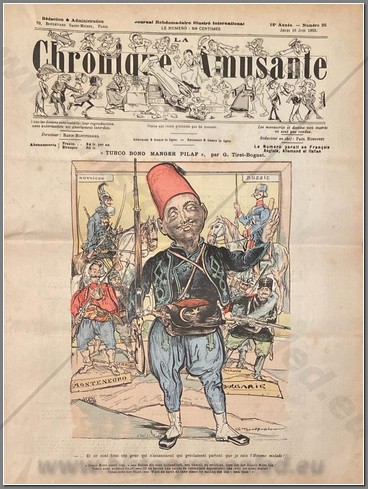
June 18, 1903 issue of Chronique Amusante, with the cover featuring a Turkish soldier among other soldiers of the Balkan States along with Russia and Austria. The caption reads “…..And it is all these people who are murdering each other who are proclaiming everywhere that I am the Sick Man!”

Price: $60.00

t-trpe108TRPE 108

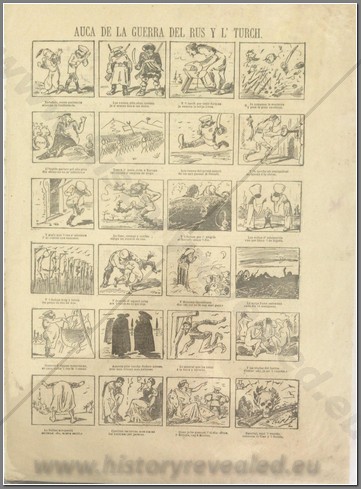
Auca de la Guerra del Rus y l’Turch. It is about the 1877-1878 Balkan war. Quite rare.

Price: $900.00

Note: An auca is a graphic format popular in Spain and especially in the region of Catalonia around Barcelona. The genre dates at least to the 17th century but was banned during the 18th century before experiencing a renewal during the 19th and later the 20th centuries as a uniquely Catalonian form of expression. It takes the form of a cartoon or a comic strip, typically with 48 blocks of image and text, although some may have less. An auca is generally produced as a single sheet, but occasionally a booklet form is used. The captions tend to have some sort of consistent rhyme to assist with the flow and storytelling. Many times, the term “auca” appears in the title, but another term, “aleluya,” is used, apparently interchangeably. Some sources indicate that the aleluya originated in Castile and originally included religious elements that were shed over time. Auca was a very popular form of anti-Nationalist propaganda during the Civil War.

t-trpe107TRPE 107


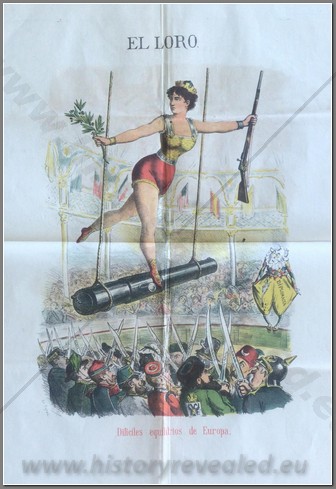
1882 issue of El Loro, showing the “difficult balances of Europe”.

Price: $120.00

t-trpe106TRPE 106

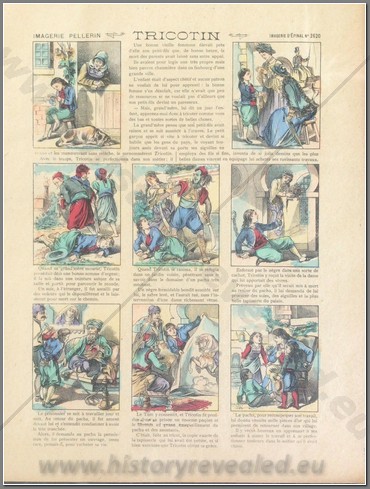
Late 19th/early 20th century Pellerin print by Imagerie D’Epinal. Titled Tricotin. Tricotin travels to Turkey where he is imprisoned. Conjuring up a magic carpet he is allowed to return home.

Price: $180.00

Note: The Imagerie d'Épinal ( Vosges ) was originally a printing house founded in 1796 by Jean-Charles Pellerin and where the first images of Épinal were engraved in series. Initially a craft, Epinal imagery gradually became a real industry. The imagery initially used an image engraved in a wooden block ( xylography ). The sheet was then printed using a hand press, called a " Gutenberg ". Then the colorist intervened: using stencils, he applied the different colors necessary to finish the work with a round brush. Around 1850 , the appearance of lithography offered greater possibilities to the artist. Nevertheless, the images of Épinal still represented only 2% of the volume of images peddled in 1860. From 1829 to 1845, the imagery celebrated the Emperor Napoleon Bonaparte, his family, his marshals, his armies and his victories. Under the influence of Rousseauist thought, mid- nineteenth - century society began to see children as consumers. Riddles, dolls to assemble, and soldiers entered the catalog of imagery. At the dawn of the 20th century, the production of imagery was known throughout the world. Puppets, paper theatres, constructions and then, during the First World War , military subjects were all areas where dissemination was significant.

t-trpe105TRPE 105

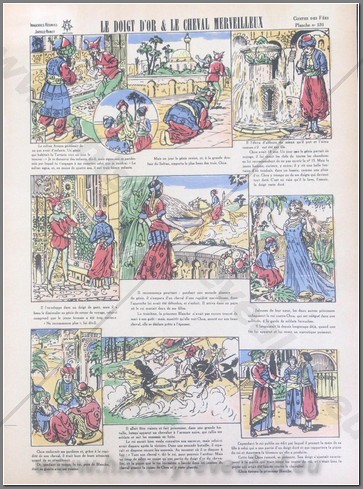
Late 19th/early 20th century Pellerin print by Imagerie D’Epinal. Titled Le Doigt D’or & Le Cheval Merveilleux. It is about a tartar sultan named Aroum and a genie.

Price: $180.00

Note: The Imagerie d'Épinal ( Vosges ) was originally a printing house founded in 1796 by Jean-Charles Pellerin and where the first images of Épinal were engraved in series. Initially a craft, Epinal imagery gradually became a real industry. The imagery initially used an image engraved in a wooden block ( xylography ). The sheet was then printed using a hand press, called a " Gutenberg ". Then the colorist intervened: using stencils, he applied the different colors necessary to finish the work with a round brush. Around 1850 , the appearance of lithography offered greater possibilities to the artist. Nevertheless, the images of Épinal still represented only 2% of the volume of images peddled in 1860. From 1829 to 1845, the imagery celebrated the Emperor Napoleon Bonaparte, his family, his marshals, his armies and his victories. Under the influence of Rousseauist thought, mid- nineteenth - century society began to see children as consumers. Riddles, dolls to assemble, and soldiers entered the catalog of imagery. At the dawn of the 20th century, the production of imagery was known throughout the world. Puppets, paper theatres, constructions and then, during the First World War , military subjects were all areas where dissemination was significant.

t-trpe104TRPE 104

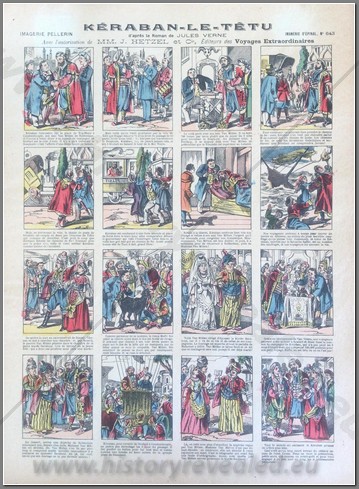
Late 19th/early 20th century Pellerin print by Imagerie D’Epinal. Titled Keraban-Le-Tetu. It is about a Turk named Keraban and his Dutch friend Van Mitten. They visit the palace in Constantinople, wherepon Van Mitten marries a Kurdish woman. He declares her dead upon arrival to Rotterdam, after which, Keraban returns to Consantinople in a balloon.

Price: $240.00

Note: The Imagerie d'Épinal ( Vosges ) was originally a printing house founded in 1796 by Jean-Charles Pellerin and where the first images of Épinal were engraved in series. Initially a craft, Epinal imagery gradually became a real industry. The imagery initially used an image engraved in a wooden block ( xylography ). The sheet was then printed using a hand press, called a " Gutenberg ". Then the colorist intervened: using stencils, he applied the different colors necessary to finish the work with a round brush. Around 1850 , the appearance of lithography offered greater possibilities to the artist. Nevertheless, the images of Épinal still represented only 2% of the volume of images peddled in 1860. From 1829 to 1845, the imagery celebrated the Emperor Napoleon Bonaparte, his family, his marshals, his armies and his victories. Under the influence of Rousseauist thought, mid- nineteenth - century society began to see children as consumers. Riddles, dolls to assemble, and soldiers entered the catalog of imagery. At the dawn of the 20th century, the production of imagery was known throughout the world. Puppets, paper theatres, constructions and then, during the First World War , military subjects were all areas where dissemination was significant.

t-trpe103TRPE 103

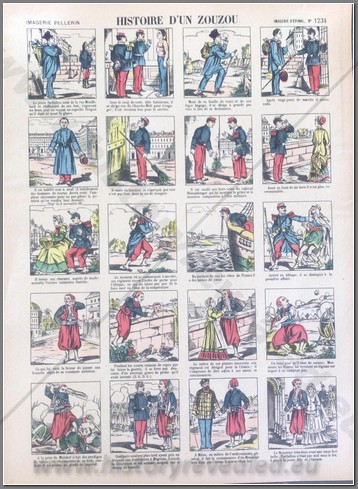
Late 19th/early 20th century Pellerin print by Imagerie D’Epinal. Titled Histoire d’un Zouzou. It is about a Frenchman who decides to become a zouave and fights in the Crimea War.

Price: $240.00

Note: The Imagerie d'Épinal ( Vosges ) was originally a printing house founded in 1796 by Jean-Charles Pellerin and where the first images of Épinal were engraved in series. Initially a craft, Epinal imagery gradually became a real industry. The imagery initially used an image engraved in a wooden block ( xylography ). The sheet was then printed using a hand press, called a " Gutenberg ". Then the colorist intervened: using stencils, he applied the different colors necessary to finish the work with a round brush. Around 1850 , the appearance of lithography offered greater possibilities to the artist. Nevertheless, the images of Épinal still represented only 2% of the volume of images peddled in 1860. From 1829 to 1845, the imagery celebrated the Emperor Napoleon Bonaparte, his family, his marshals, his armies and his victories. Under the influence of Rousseauist thought, mid- nineteenth - century society began to see children as consumers. Riddles, dolls to assemble, and soldiers entered the catalog of imagery. At the dawn of the 20th century, the production of imagery was known throughout the world. Puppets, paper theatres, constructions and then, during the First World War , military subjects were all areas where dissemination was significant.

t-trpe102TRPE 102


January 28. 1877 issue of Le Grelot, showing England propping up Turkey during the Balkan Wars.

Price: $180.00

t-trpe101TRPE 101


May 23, 1909 issue of Le Petit Parisien showing the investiture of Sultan Mehmed V.

Price: $90.00

t-trpe100TRPE 100


October 31, 1908 issue of Le Rire showing King Ferdinand of Bulgaria and a blood thirsty Sultan Abdul Hamid II.

Price: $90.00

Copyright © 2013-2024 History Revealed