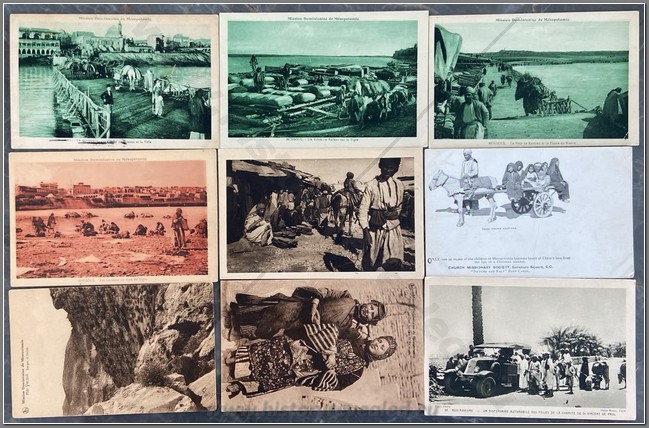
 PR 111
Collection of 9 colonial postcards of French and English missionary activity in Mesopotamia, with much on Mossul.
Price: $270.00

PR 111
Collection of 9 colonial postcards of French and English missionary activity in Mesopotamia, with much on Mossul.
Price: $270.00
 PR 110
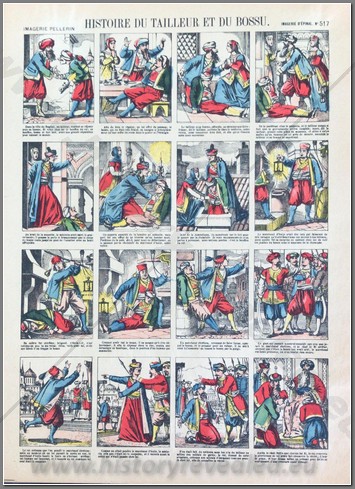
Late 19th/early 20th century Pellerin print by Imagerie D’Epinal. Titled Histoire du Tailleur et du Bossu. It takes place in Baghdad. SOLD
Price: $70.00
Note: The Imagerie d'Épinal ( Vosges ) was originally a printing house founded in 1796 by Jean-Charles Pellerin and where the first images of Épinal were engraved in series. Initially a craft, Epinal imagery gradually became a real industry. The imagery initially used an image engraved in a wooden block ( xylography ). The sheet was then printed using a hand press, called a " Gutenberg ". Then the colorist intervened: using stencils, he applied the different colors necessary to finish the work with a round brush. Around 1850 , the appearance of lithography offered greater possibilities to the artist. Nevertheless, the images of Épinal still represented only 2% of the volume of images peddled in 1860. From 1829 to 1845, the imagery celebrated the Emperor Napoleon Bonaparte, his family, his marshals, his armies and his victories. Under the influence of Rousseauist thought, mid- nineteenth - century society began to see children as consumers. Riddles, dolls to assemble, and soldiers entered the catalog of imagery. At the dawn of the 20th century, the production of imagery was known throughout the world. Puppets, paper theatres, constructions and then, during the First World War , military subjects were all areas where dissemination was significant.
 PR 109
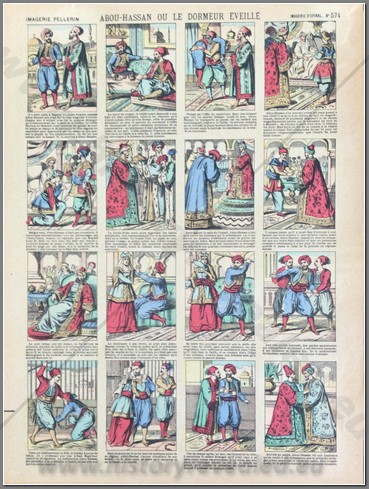
Late 19th/early 20th century Pellerin print by Imagerie D’Epinal. Titled Abou-Hassan ou le Dormeur Eveille. It takes place in Baghdad. SOLD
Price: $70.00
Note: The Imagerie d'Épinal ( Vosges ) was originally a printing house founded in 1796 by Jean-Charles Pellerin and where the first images of Épinal were engraved in series. Initially a craft, Epinal imagery gradually became a real industry. The imagery initially used an image engraved in a wooden block ( xylography ). The sheet was then printed using a hand press, called a " Gutenberg ". Then the colorist intervened: using stencils, he applied the different colors necessary to finish the work with a round brush. Around 1850 , the appearance of lithography offered greater possibilities to the artist. Nevertheless, the images of Épinal still represented only 2% of the volume of images peddled in 1860. From 1829 to 1845, the imagery celebrated the Emperor Napoleon Bonaparte, his family, his marshals, his armies and his victories. Under the influence of Rousseauist thought, mid- nineteenth - century society began to see children as consumers. Riddles, dolls to assemble, and soldiers entered the catalog of imagery. At the dawn of the 20th century, the production of imagery was known throughout the world. Puppets, paper theatres, constructions and then, during the First World War , military subjects were all areas where dissemination was significant.
 PR 108
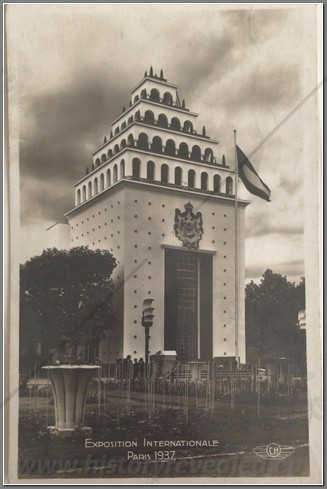
Postcard of the Iraq pavilion at the 1931 Paris International Exposition.
Price: $30.00
 PR 107
Colonial postcard of jews of Yemen.
Price: $60.00
 PR 106
 PR 106
1918-1920 photo album of Baghdad from a British soldier based there during the war. Shown are various buildings, paddle steamer, general headquarters, RAF HQ, RS Kalipha, horse drawn tramway, Hindyah Barrage, Brooking bridge, Maude bridge, military camp at Basrah, native entertainers, bridge at Amara, gunboat “Gadfly”, infants getting married, more. The album then goes on his time after the war, in Englan, from 1922-1925. He visits the 1924 British Empire Exhibition at Wembley. 31 well captioned photos of his time in Iraq.
Price: $400.00
 PR 106 PR 106 |  PR 106 PR 106 |  PR 106 PR 106 |  PR 106 PR 106 |
 PR 105
Early postcard of the Sultan’s Mosque at Lahez.
Price: $30.00
 PR 104
Photo on postcard stock. Manuscript notation on back reads “Construction staff taking water, rail head Minjawa, Persia, during construction of railway to the Caspian via Persia and Afghanistand during the great war”.
Price: $40.00
 PR 103
 PR 103
Photo postcard of a Persian fortress in 1925. Photo by V. Krassovskey. B
Price: $60.00
 PR 102
Postcard of French military in Arabia. B
Price: $50.00