Africa General

t-afg193AFG 193


Four European chromos showing both native and colonial hunting in Africa. Cafes Torrefies, lingerie producer A. Besnard and an unidentified Spanish confectioner.

Price: $120.00

t-afg192AFG 192


Four European chromos showing medicine in Africa. Reddings Tea, Liebig Beef Extract.

Price: $120.00

t-afg191AFG 191


Three European chromos showing African dance and masks. Liebig Beef Extract, Chocolates Batanga, Reddings Tea.

Price: $90.00

t-afg190AFG 190


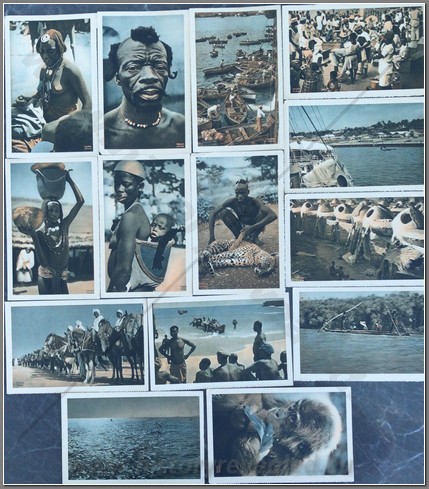
Nine European chromos showing native life through a colonial lens. Baydex Cigarettes, Peter Jackson Cigarettes, Lavazza Coffee, Liebig Beef Extract, Chicoree Extra C. Berlot, Maussion Freres.

Price: $300.00

t-afg189AFG 189


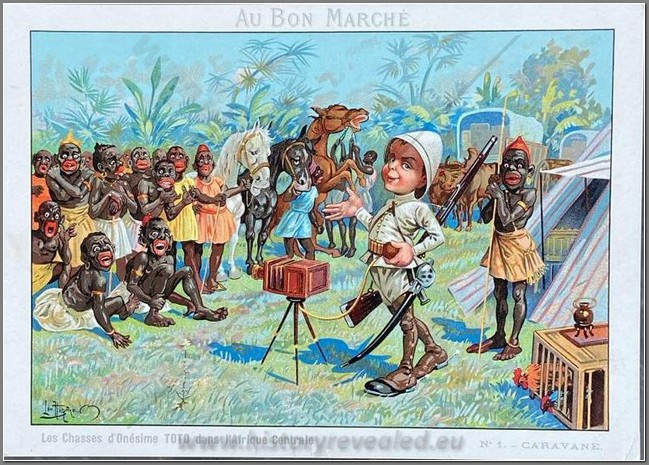
Ten European chromos showing the interaction between Europeans and Africans and reflecting the colonial influence on the local population. Chocolat d’Aiguebelle, Player’s cigarettes, Au Bon Marche, Ardath Tobacco, Eau des Carmes Boyer, Chocolat Revillon, Chocolat Guerin-Boutron, Cibils.

Price: $300.00

t-afg188AFG 188

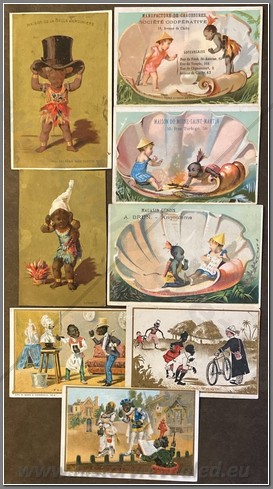
Thirteen early European chromos showing African stereotypes. “Bamboula” is freely used despite its derogatory use. Also shows a confectioners product being used by “savages”. In some cases, such as “La Nubienne” you have a household dye being named after an African ethnic group. Some confectioners advertise their use of African raw materials. Chocolats Guerin-Boutron, Biscuits-Scapini, lingerie producer a. Besnard, Fabrica de Chocolate Bubi de la Compania Colonial de Africa, Chocolates Amatller, La Nubienne and some unidentified chromos.

Price: $390.00

t-afg187AFG 187


Five early European chromos showing Africa in allegory. Chicoree producer Protez-Delatre, Chocolat de Planteur, L’Abeille D’Or, Au Fidele Berger, Chicoree Jh. Lerevilles.

Price: $250.00

t-afg186AFG 186


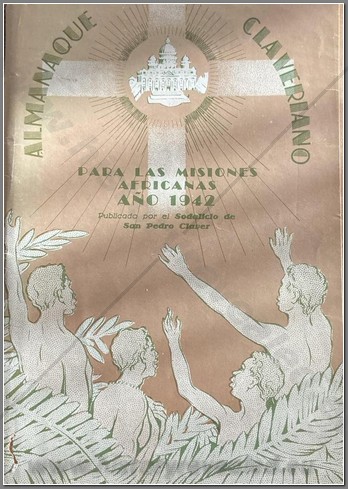
Almanaque Claveriano, 1942. YH

Price: $90.00

t-afg185AFG 185

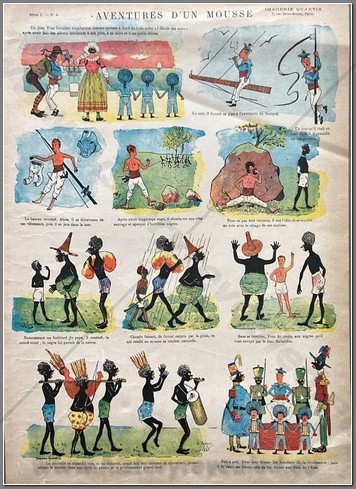
Late 19th/early 20th century Pellerin print by Imagerie D’Epinal. Titled Aventures D’un Mousse, it is about a French sailor named Yves, who falls off his ship and ends up in Africa. He paints himself black to blend in with the locals. When it rains his paint washes off and he is revered by the locals. The last frame reads “Little by little, Yves gave them the benefits of civilization; then he brought his brothers over, in order to raise them at the expense of the state.”

Price: $100.00

NOTE: The Imagerie d'Épinal ( Vosges ) was originally a printing house founded in 1796 by Jean-Charles Pellerin and where the first images of Épinal were engraved in series. Initially a craft, Epinal imagery gradually became a real industry. The imagery initially used an image engraved in a wooden block ( xylography ). The sheet was then printed using a hand press, called a " Gutenberg ". Then the colorist intervened: using stencils, he applied the different colors necessary to finish the work with a round brush. Around 1850 , the appearance of lithography offered greater possibilities to the artist. Nevertheless, the images of Épinal still represented only 2% of the volume of images peddled in 1860. From 1829 to 1845, the imagery celebrated the Emperor Napoleon Bonaparte, his family, his marshals, his armies and his victories. Under the influence of Rousseauist thought, mid- nineteenth - century society began to see children as consumers. Riddles, dolls to assemble, and soldiers entered the catalog of imagery. At the dawn of the 20th century, the production of imagery was known throughout the world. Puppets, paper theatres, constructions and then, during the First World War , military subjects were all areas where dissemination was significant.

t-afg184AFG 184


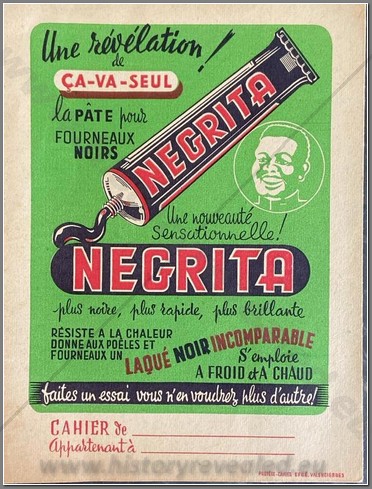
French children’s school book cover advertising NEGRITA. It was a black stove paste. Circa 1920.

Price: $90.00

Copyright © 2013-2024 History Revealed