Postcard Collections

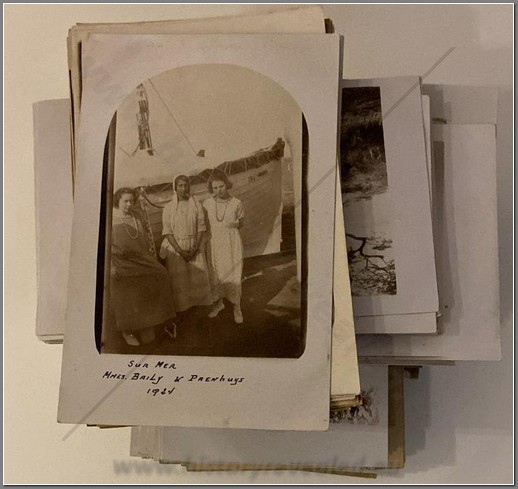
t-ba185BA 185Photo collection belonging to an English engineer working on installing floatation plants in the mining-rich region of Haut-Katanga province in the Belgian Congo, from 1923-1925. He was employed by the Union Miniere Du Haut-Katanga, a Belgian mining company with a minority British shareholding. He served at various mining locations, such as Panda, Kapolowe, Kanseria, Lufira, Kalabi, Muchikitala, Kukontwe and Elizabethville (provincial capital). A number of colonial company employees are named (Bedecker, Schneider, Nottel, Vandeer Herreweghen, Gasquard, Viroux) as well as local natives (Pierre Ketche, Kapita Sitanda, Sicubari, Baluwani). Much on native worker compounds for both the Union Miniere Du Haut-Katanga (UM) and the Compagnie de Chemin de Fer du Katanga (CFK). Many photos of whites and natives working together, a local sultan, rail stations, mining operations, native life, colonial living separate from native living, brick making, Mission station, white employees wives, transporting a car on a river barge, hunting, interior views of a colonial home, a visit by a senior colonial official, local ascaris, the1923 Exposition Agricole, native life on a company compound, building construction, funeral for a local native employee, natives mining uranium (note: In 1922, the UMHK built its first refinery for uranium ore, and by 1926 had a virtual monopoly of the world uranium market), local habits, rare photo of the Hotel Metropole in Elizabethville (now demolished), natives transporting a steam engine through the bush, colonial buildings in small mining locals, open pit mining, train wreck, military parade by local ascaris on July 7 1923. He travels from London to Madeira, then to Capetown before arriving in Elizabethville. 280 photos in all.

Price: $2200.00

NOTE: Most of the mining sites and towns are located in the province of Haut-Katanga. The area prospered with the development of a regional copper mining industry. Huge investments in the 1920s, both in the mining industry and in transport infrastructure (railline Elisabethville-Port Francqui and Elisabethville-Dilolo), developed the Katanga province into one of the world's major copper ore producers. This photo archive relates to this period.
t-ba184BA 184


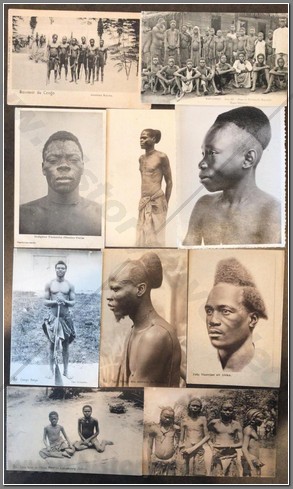
10 colonial postcards of different male types. Shown are a Senegalese, Pahouins, Mobeka warriors, Bateke, Turumbu region, more.

Price: $900.00

t-ba182BA 182

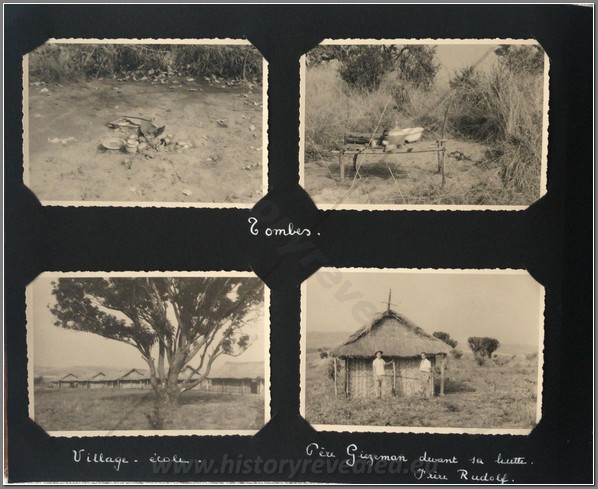
Photo album belonging to Comte (Count) Marc Minette d’Oulhaye while trekking through  the Belgian Congo. There is a note at the front of the album with a list of goods he purchased for a trip. This album covers a trip he apparently took to the Belgian Congo in the 1950’s. It covers Kwango, Wamba, Kenge, Bakali, Swa-Kilemba, Kwilu, Inzia, Kalonda, Kimbau, Kingombe, Mulope-Isunda, missionaries departing Kimbau for Matari, Bakali, Ndolo. Shows unusual village tombs as well as Christian cemeteries, various named missionaries, village life, local school, the site of a future Mission, various named local Christians, aerial views of the bush, more. 153 photos.

Price: $900.00

Note from the internet:  Count Marc Marie Joseph Minette d’Oulhaye (1875–1959) was a prominent Belgian mining engineer, colonial administrator, and author. He played a major role in the early 20th-century geological and industrial exploration of the Belgian Congo.  He was born on October 12, 1875, in Saint-Georges-sur-Meuse, Belgium and graduated as a civil mining engineer from the Association des Ingénieurs sortis de l'École de Liège. In June 1910, he joined the newly formed Géomines (Compagnie géologique et minière des Ingénieurs et Industriels belges), a major mining syndicate tasked with exploring mineral rights in northern Katanga. He was chosen to lead early, high-stakes exploration missions into the African interior. He served as a principal director and managing administrator (administrateur-directeur) of Géomines, launching multiple geological expeditions. He resigned from his executive post at Géomines in 1933 to offer his extensive consulting experience to other geological and mining corporations.

Beyond engineering, he was known as a talented man of letters. He wrote tropical-themed fiction and sketches drawn directly from his time in Africa. His most notable work is the 1924 novel Malila: croquis tropicaux d'après nature (par 6° de latitude et 30° à l'ombre). Because of his dual status as an intellectual and an engineer, he was elected president of the Association des Écrivains et Artistes coloniaux (Association of Colonial Writers and Artists). He held the title of Count (Comte / Comes Romanus). On May 29, 1922, he married Countess Élisabeth d'Aspremont Lynden (1883–1947) in Brussels. Their daughter, Monique Minette d'Oulhaye (1923–1979), married Prince Léopold Emmanuel de Croÿ, connecting the family to the ancient, princely European House of Croÿ. Count Marc passed away in Uccle, Belgium on April 3, 1959, at the age of 83.

t-ba181BA 181

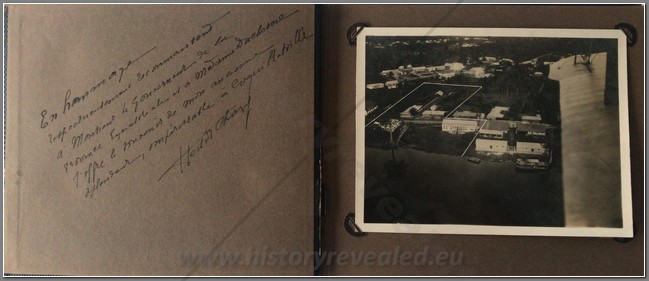
Album of 22 photos belonging to Hector Chazy, a major landowner in the area of Coquilhatville, purchasing 60 acres of land in 1926/1927. He gives the album to the governor of Equatoria, Charles Duchesne and his wife as a souvenir of Coquilhatville and writes them a note at the front of the album. Aerial photo of his land, Chazy’s home, other buildings he constructed. He owns a local factory, S.A.V.C.H.A., established in 1910. Shown are his factory, loading product onto a river boat at “Shore Chazy”, for the Savon expedition. At the end there is a news article about Chazy and that he brought back a sports canoe with oars and that he will traverse Stanley Pool, that he left Kinshasa and arrived in Brazzaville 42 minutes later, despite the terrible current. There is a photo of Chazy in his boat. All photos with captions.

NOTE: Hector Chazy (often identified in historical vital records as Philibert Hector Chazy) was a prominent French colonial settler, agriculturalist, and notable landowner in Coquilhatville (now known as Mbandaka), situated in the Équateur province of the Belgian Congo. While he is a lesser-known figure in mainstream history textbooks compared to the high-ranking Belgian administrators, he represents a specific, powerful class of independent foreign "planters" (colons) who shaped the agricultural and social landscape of the Congo River basin during the early-to-mid 20th century.

Born in France (the son of Antoine Marie Chazy and Claudine Tissier), Chazy was one of the many non-Belgian Europeans (alongside various French, Portuguese, and Greek nationals) who moved to the Belgian Congo to seek their fortunes in private enterprise.  Coquilhatville was a highly strategic administrative and trading hub located directly on the Congo River, precisely where it crosses the equator. Chazy acquired significant land concessions in the immediate vicinity of the city. His estates were primarily used for commercial plantations. In the Coquilhatville region, this typically meant cultivating rubber, palm oil, or cocoa, which were the primary cash crops of the Équateur province. Planters like Chazy managed vast private estates that operated alongside the massive corporate concessions owned by conglomerates like Unilever (Huileries du Congo Belge).

 The acronym S.A.V.C.H.A. likely stands for Société Anonyme des Savonneries Chazy (or Savonnerie de Coquilhatville Hector Chazy). Established remarkably early in 1910, this factory processed raw local palm oil directly at the source to manufacture soap (savon). Chazy was not just a landowner; he controlled the entire supply chain. He grew the palm fruit on his estates, extracted the oil, manufactured the soap in his factory, and used his private riverfront dock—"Shore Chazy"—to load the cargo onto riverboats for domestic and export trade (the "Savon expedition"). The 60 acres he purchased during 1926/7 likely marked a major expansion of his estate or factory grounds, right at the height of Governor Duchesne's administration. The news article at the end captures a fascinating glimpse of Chazy's personal character—he was an adventurer and a sportsman, a trait highly romanticized among European settlers at the time. Despite looking calm in places, Stanly Pool is notorious for its lethal, swirling currents and rapid water shifts just before the river plunges into the Livingstone Falls. Crossing the pool in a sports canoe with oars in just 42 minutes was a genuine athletic feat. Navigating those currents using raw human muscle power, rather than a steamboat engine, would have made him a local celebrity in the colonial press.

What Makes This Album Nationally/Historically Significant?  Most historical records focus on massive corporate conglomerates like Unilever (Huileries du Congo Belge). This album is rare visual proof of a highly successful, independent private entrepreneur competing in the same space.  An aerial photo from 1926/1927 is incredibly rare. Aviation was in its absolute infancy in the Congo during the mid-1920s; Chazy likely commissioned a pilot from early colonial air transport routes to photograph his empire from above.

Price: $700.00

t-ba179BA 179


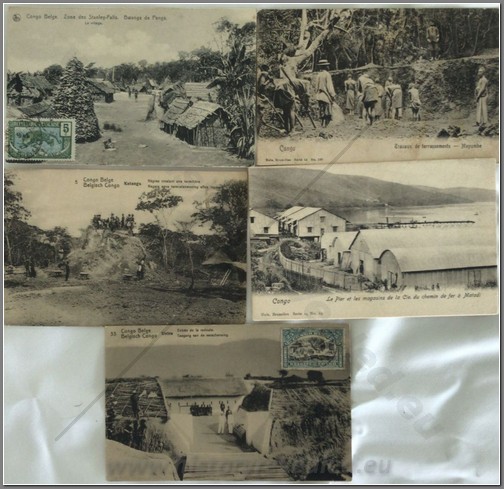
5 postcards of colonial and local activity in the Belgian Congo: village life, locals constructing a road, locals levelling a termite mound, pier and stores at Matadi, entry to a redoubt.

Price: $150

t-ba178BA 178


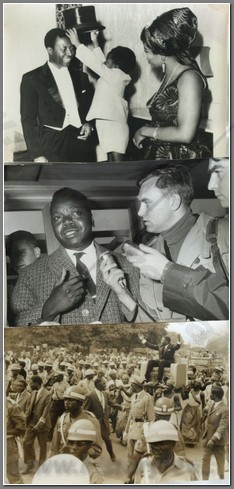
3 French press photos: 2 of president Moise Tschombe and one of ambassador Joseph Kabema.

Price: $90.00

t-ba175BA 175t-ba175aBA 175t-ba175a1BA 175

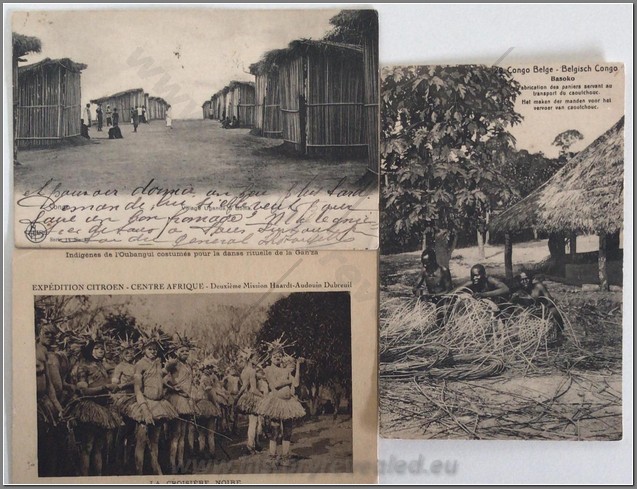
25 colonial postcards of different villages, different hut types and village life in the Belgian Congo. Shown are the village of the island of princes opposite boma; a workers village; transporting passengers at Malela; making earthworks at Mayumbe; the monolith at Boma; market at Boma; Banana; Bobo; a Bwangwa village; a lumber post at Stanley-Pool; houses of indigenous planters at Stanleyville; a Bateke village; a Djabbir village; village on the Lomami river, a Ugandan village.

Price: $750.00

t-ba169BA 169


5 satirical comical postcards of the Belgian Congolese. One postcard is trimmed. Two postcards have handwritten comments on reverse. EH

Price: $120.00

t-ba168BA 168


Two high quality early colonial large format photos of a local courtroom. B

Price: $100.00

t-ba166BA 166t-ba166aBA 166t-ba166a1BA 166


Interesting home-made album on the Belgian Congo by confectioner Toffees Trefin. Done during the 1950’s visit of the king of Belgian to the colony. All 100 cards present. B

Price: $990.00

Copyright © 2013-2024 History Revealed