Algeria, Tunisia

tn369TN 369


Six colonial humour postcards produced in Algeria.

Price: $180.00

tn368TN 368


Two picturesque postcards of Alger from the series Cadre Style Arabe.

Price: $60.00

tn367TN 367Photo album belonging to a Spaniard fighting with the Foreign Legion in Algeria during the Independence War. His name was Andres Segui. Based in northwest Algeria at Saida and then Colomb Bechar, he was with the 2nd Foreign Infantry Regiment (2e REI). Some of the photos were taken by famed French war photographer Arthur Smet. Shown are combat operations around Saida with tanks, infantry and helicopters; life at Camp Croze (located at Colomb Bechar, which became the new HQ of the 2e REI in 1963. It was named after its last officer killed during the Algerian War, Lieutenant Louis de Croze de Clesmes); captured rebel weapons; Christmas and New Year’s celebrations (some displays in German as some in the Legion were former Germany military); photos showing the conversion of the 2e REI into a motorized infantry regiment (the very first in the Legion); AMM8 armored cars during an operation in the Ain Sefra region; spectacular aerial view (and interior views) of the 2e REI camp at Djenane (which housed the 4th company in 1963); monument to fallen Legion dead during the Battle of El Moungar in 1903. Also a souvenir from his time at Camp D’Arue in French Polynesia following his time in Algeria. Nice photo of Segui posing beside a plaque honoring the 4th Battalion of the 2e REI (no doubt because that battalion was almost exclusively Spanish so it was a nostalgic photo). 75 photos, none captioned, plus some ephemera. tn367aTN 367

Price: $1500.00

NOTE: Following service during the Indochina War, from 1955 to 1956 the 2e REI was assigned to Tunisia, then Morocco. From 1956 to 1962 it participated in combat operations during the Algerian War. Then from 1962 to 1967 it was placed at the disposition of central command of military sites in the Sahara until it was finally dissolved in 1968. It was the first motorized infantry regiment in the Legion the last Legion regiment to leave North Africa, in 1968.

The military operations shown in the album were fought in the northwest and likely one or more of the following battles in 1958: Battle of Jebel Bouatriss (January 7), Battle of El-Labba (February 7), Battle of Wadi El-Kefah (March 10) and/or the Battle of El-Loukda (March 12).

NOTE: tn367a1TN 367Arthur Smet (1932- ) is a French photographer who came to cover the war in Algeria in 1955. In 1959 he was assigned to the Saida sector and impressed the overall commander General Marcel Bigeard. From then on, his photographic practice experienced a resurgence and became professionalized, partly thanks to Marc Flament, who briefly taught him the techniques, but above all with the support of the military authorities, who provided him with the means to exercise his talent without constraint or censorship. Following in Flament's footsteps—and operating outside the SCA (Service de Combat d'Action Algérienne)—Arthur Smet became a key figure in the psychological warfare operations "à la Bigeard," providing photographic coverage of the Saïda sector for the creation of information halls. These large walls of images, strategically placed to be visible to all in public spaces, were accompanied by slogans promoting France's health and social programs for Algerians, everyday civic, military, and political life, and finally, the military successes of the newly formed Georges and Cobra commando units in this operational sector. With the exception of a stay in Constantine during the autumn of 1960, Arthur Smet's photographs are set in the Saïda region, southern Oran , and Oran itself . Several of his photos were published at the time in local newspapers such as L' Écho d'Oran and L' Écho de Saïda. In 1963, Arthur Smet took a boat to France and left Algeria for good after an eight-year stay.

tn366TN 366


Algerian humor postcard by Chagny showing a Frenchman with a rifle emerging from a place that forbids hunting, questioning a local Algerian how to get to Algiers.

Price: $40.00

tn365TN 365

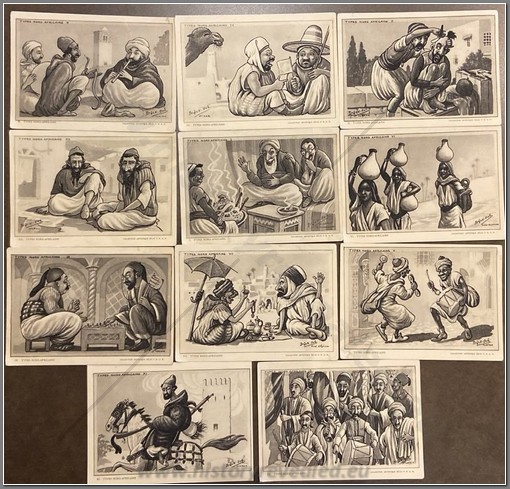
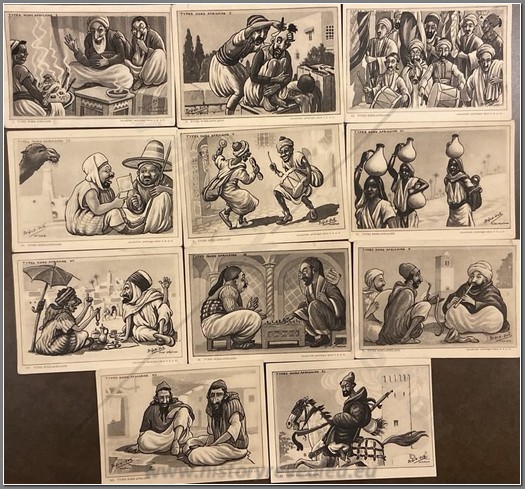
10 colonial humor postcards of Algerian life by illustrator Roger Irriera.

Price: $400.00

NOTE: Roger Jouanneau Irriera (1884-1957) travelled to Lebanon, Palestine, Egypt and Sudan in 1921-1922 and produced a number of important works. Moving to Algeria in 1925, he exhibited to the Algiers Initiative Union and on this occasion was entitled to an illustrated article Terre d'Afrique magazine. At the request of the Algerian publisher-printer Baconnier, Irriera produced numerous posters for airlines Algerian railways and Saharan tourism. During this period, he also went to Tunisia and Morocco where he constantly drew portraits, street scenes, small trades, etc.

tn364TN 364

13 colonial humor postcards of Algerian life by illustrator E. Herzig.

Price: $500.00

NOTE: Édouard Herzig (23 December 1860 – 3 October 1926) was a Swiss painter, drawer and illustrator who lived in French Algeria.

tn363TN 363


16 late colonial propaganda postcards by the French Forces Militaire in Algeria.

Price: $480.00

tn362TN 362tn362aTN 362


16 satirical colonial postcards of arab life in Algeria, by the artist Chagny. KH

Price: $480.00

tn361TN 361

Late 19th century patriotic Pellerin print by Imagerie d’Epinal. It shows the battle of Djebbel-Haddedah, fought in Tunisia April26, 1881. It reads “General Ritter's troops, Zouaves and Turcos, scaled part of the Djebbel-Haddedah mountains from the flanks, while artillery fire from the front cleared them of the numerous Kroumir corps occupying them. The enemy, after suffering heavy losses, was driven back into the Oued-djenan valley; among the dead were Tunisian officers and soldiers. Our losses were light, amounting to 3 men killed and 15 wounded.”

Price: $200.00

NOTE: The Imagerie d'Épinal ( Vosges ) was originally a printing house founded in 1796 by Jean-Charles Pellerin and where the first images of Épinal were engraved in series. Initially a craft, Epinal imagery gradually became a real industry. The imagery initially used an image engraved in a wooden block ( xylography ). The sheet was then printed using a hand press, called a " Gutenberg ". Then the colorist intervened: using stencils, he applied the different colors necessary to finish the work with a round brush. Around 1850 , the appearance of lithography offered greater possibilities to the artist. Nevertheless, the images of Épinal still represented only 2% of the volume of images peddled in 1860. From 1829 to 1845, the imagery celebrated the Emperor Napoleon Bonaparte, his family, his marshals, his armies and his victories. Under the influence of Rousseauist thought, mid- nineteenth - century society began to see children as consumers. Riddles, dolls to assemble, and soldiers entered the catalog of imagery. At the dawn of the 20th century, the production of imagery was known throughout the world. Puppets, paper theatres, constructions and then, during the First World War , military subjects were all areas where dissemination was significant.

tn360TN 360

Late 19th/early 20th century patriotic Pellerin print by Imagerie D’Epinal. Titled Chef de File, it is about a French zouave named Kelcouen and his life as a zouve. He is transferred to Algeria. The last frame reads: “The following year, if you had been to Constantine, you could have seen the brave Zouave First Class Kelcouen, part of the flag guard of the same decorated Zouaves, for whom the old recruit would have given his last drop of blood.”

Price: $200.00

NOTE: The Imagerie d'Épinal ( Vosges ) was originally a printing house founded in 1796 by Jean-Charles Pellerin and where the first images of Épinal were engraved in series. Initially a craft, Epinal imagery gradually became a real industry. The imagery initially used an image engraved in a wooden block ( xylography ). The sheet was then printed using a hand press, called a " Gutenberg ". Then the colorist intervened: using stencils, he applied the different colors necessary to finish the work with a round brush. Around 1850 , the appearance of lithography offered greater possibilities to the artist. Nevertheless, the images of Épinal still represented only 2% of the volume of images peddled in 1860. From 1829 to 1845, the imagery celebrated the Emperor Napoleon Bonaparte, his family, his marshals, his armies and his victories. Under the influence of Rousseauist thought, mid- nineteenth - century society began to see children as consumers. Riddles, dolls to assemble, and soldiers entered the catalog of imagery. At the dawn of the 20th century, the production of imagery was known throughout the world. Puppets, paper theatres, constructions and then, during the First World War , military subjects were all areas where dissemination was significant.

Copyright © 2013-2024 History Revealed