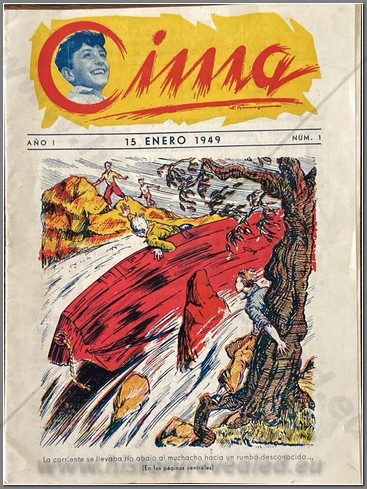
 MOB 380
87 issues plus 2 almanaques of CIMA, Publication para la formacion Cristiana de la juventud. Published in Barcelona, this catholic youth magazine ran from 1949-1954. Not shown in WORLDCAT.
Price: $5200.00

MOB 380
87 issues plus 2 almanaques of CIMA, Publication para la formacion Cristiana de la juventud. Published in Barcelona, this catholic youth magazine ran from 1949-1954. Not shown in WORLDCAT.
Price: $5200.00
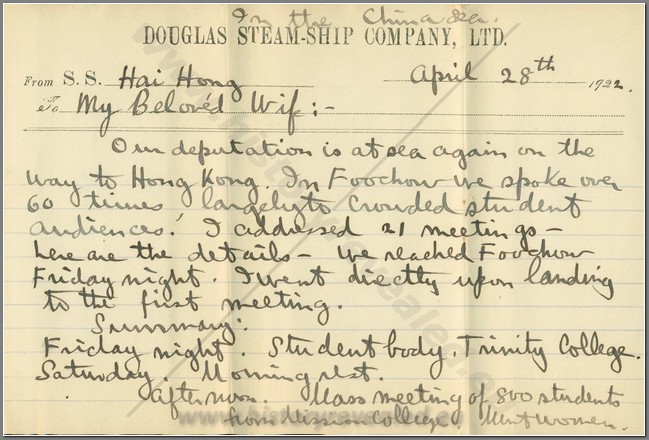 MOB 379
Two letters from missionary S. Ralph Harlow. One is to his wife, dated April 28, 1922. It gives a detailed itinerary of his Far East Missionary trip. The letter contains the letterhead of the Douglas Steam-Ship Company, LTD. The second letter, written on the same day, is to his children. He writes “Nearly every day Daddy has been telling the story of Jesus and His love to hundreds of boys and girls in China. Today I told this old, old story to over 600 boys and girls. Many of these children are afraid of devils and idols. They do not know of Jesus and of God's love and care and protection. I have been in a town where they sell little girl babies for a few dollars. Don't you think they need to know of Jesus?"
Price: $150.00
NOTE from Wikipedia: S. Ralph Harlow (20 July 1885 – 21 August 1972) was an American clergyman and Christian missionary to the Middle East. He was born in Boston and graduated from Harvard University in 1908 and from Union Theological Seminary in 1912. He obtained an M.A. from Columbia University and a PhD from Hartford Theological Seminary. He was ordained Congregational minister in 1912 and worked for the American Board of Commissioners for Foreign Missions in Smyrna and Turkey. Harlow was Chaplain and Sociology teacher at the International College in Smyrna from 1912-1922. He worked for the Young Men's Christian Association with the American Expeditionary Force in France until 1922. He was a lecturer for the Carnegie Endowment for International Peace.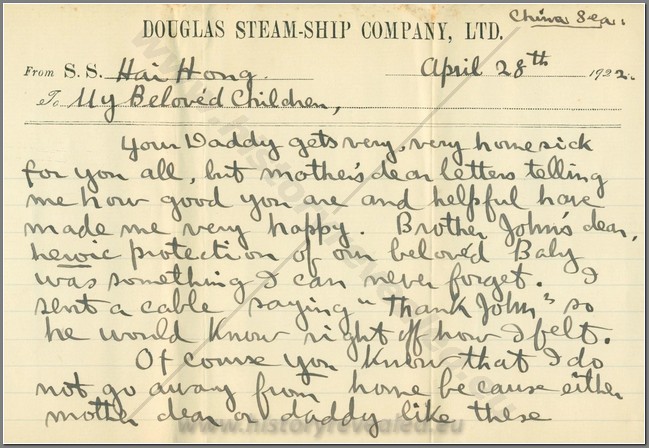 MOB 379
He joined the faculty of Smith College faculty in 1923 where he was professor of religion for over thirty years. He was a Socialist candidate for the House of Representatives from Northampton, Massachusetts in 1932. Harlow was a friend of Norman Thomas and advocated for a pacifist philosophy. He was a director of the National Association for the Advancement of Colored People and a member of the American Christian Palestine Committee. He held interest in the paranormal and once claimed to have observed floating angels with his wife. He wrote about psychical phenomena from a Christian perspective and was convinced that there was life after death.
In 1953, the Marion and S. Ralph Harlow Scholarship Fund was established for students. Harlow received an honorary degree of Doctor of Humane Letters from the Hebrew Union College in New York. He was one of the few Christians to be honoured by a Jewish institution. Nelson Glueck commented that Harlow "has actively associated himself with Jewish causes, with Israel and its Hebrew University, and without respect to race and creed, has expended in a humble and perceptive way, a warmth of human sympathy". Harlow died in Northampton, Massachusetts on 21 August 1972, aged 87. He is buried at Abels Hill Cemetery in Massachusetts.
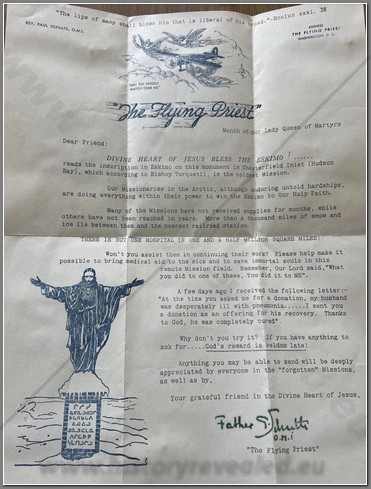 MOB 378
Late 1930’s newsletter from Father Paul Schulte, the “Flying Missionary”, in Engish and part Inuit.
Price: $90.00
NOTE: Paul Schulte OMI (1896 – 1975), was a German priest and missionary, known as the "Flying Priest", who founded MIVA ("Missionary International Vehicular Association") to provide automobiles, boats and airplanes for the service of missions throughout the world. Schulte's training for the priesthood was interrupted by the outbreak of World War I. He was conscripted and served in the Prussian 4th Guard Grenadier Regiment. After 21⁄2 years he was wounded. On his recovery he joined the Air Force to be trained as a pilot, and served in Palestine. Following the war he returned to his studies at the scholasticate in Hünfeld, and was ordained an Oblate Priest of the Missionary Oblates of Mary Immaculate in 1922. As a first obedience he was sent to South Africa as a missionary.
In 1925 his childhood friend and fellow soldier Father Otto Fuhrmann died in South-West Africa of pneumonia complicated by malaria. It had taken him five days to reach the hospital of the Protestant Finnish mission where he died. This led Fr. Schulte to found MIVA, the "Missionalium Vehiculorum Association", known in German as the "Missions-Verkehrs-Arbeitsgemeinschaft", and the "Missionary International Vehicular Association" in English, to provide training and modern vehicles for missionaries, especially in Africa, Asia and Latin America, with the motto Obviam Christo terra marique et in aera ("Toward Christ by land and sea and in the air"). Despite some opposition from his superiors he finally received the blessing of the Archbishop of Cologne. In 1929 Schulte made his first journey to the United States to raise funds. Finally the Pope himself gave his unqualified approval.
On May 8, 1936, Father Schulte flew to the US on the airship Hindenburg and with papal permission celebrated the world's first aerial Mass in memory of his brother Lieutenant Franz Schulte who had died of influenza in 1919 while a POW in Raikeswood POW camp, Skipton, West Riding, Yorkshire, England. While over Keighley he dropped a parcel containing a bunch of carnations, a small silver and jet crucifix, some postage stamps, a picture postcard and some Hindenburg notepaper. It was found by two Scouts, who placed the carnations on Franz Schulte's grave. The following day, another mass followed, specifically for the crew. By that time MIVA had bought a dozen aircraft, and more than 150 automobiles and motorboats, used by mission stations in Albania, Latvia, Africa, Madagascar, Korea, New Guinea, Brazil and the Solomon Islands.
Schulte was then assigned to a parish in Northern Canada. There, in August 1938, Schulte mounted a 2,200 mile medical evacuation on behalf of Father Julien Cochard from Arctic Bay, the most northerly Catholic mission in the world, to Chesterfield Inlet. In his Stinson Reliant floatplane Schulte flew through storm force winds and thick fog in order to rescue Cochard, and received a special blessing from Pope Pius XI for his services.
Schulte was transferred to St. Henry's Seminary in Belleville, Illinois during World War II where he helped found the National Shrine of Our Lady of the Snows. He continued his work with MIVA until his death in Swakopmund, Namibia, in 1975. He is buried beside his boyhood friend, Father Otto Fuhrmann.
 MOB 377
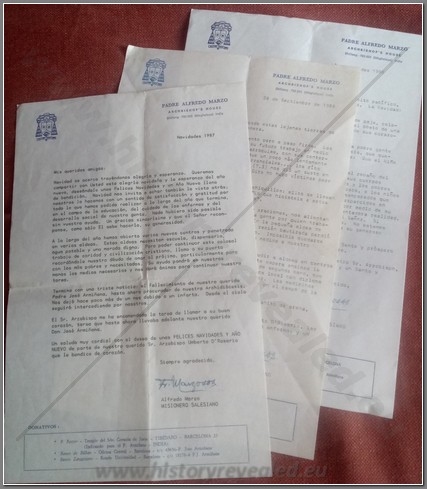
Three letters from the Salesian Missionary ALFREDO MARZO - 1987/88 – INDIA.
Price: $90.00
NOTE: Fr. Alfredo Marzo is a dedicated Spanish Salesian missionary who has spent over seven decades serving in northeast India, particularly among the tribes in Meghalaya. Based in the remote jungle territory of Shallang, he is renowned for his work in education, rural development (roads, wells, rice fields), and healthcare, describing himself as "the happiest man in the world". Born in Lodosa, Navarra (Spain), he was inspired to join the missions after meeting Salesian missionaries from India during his training. He focuses on evangelization, education for youth, and establishing parish infrastructures in remote areas. His efforts in Shallang, India, have significantly improved the lives of thousands of families. As of late 2025, he has celebrated over 70 years as a missionary, continuing his work at over 90 years of age. He is known for using a vehicle that often serves as an emergency ambulance for local people, transporting them to distant hospitals. He is a living testament to the Salesian presence in India and is highly regarded by his community and the local people he serves.
 MOB 376
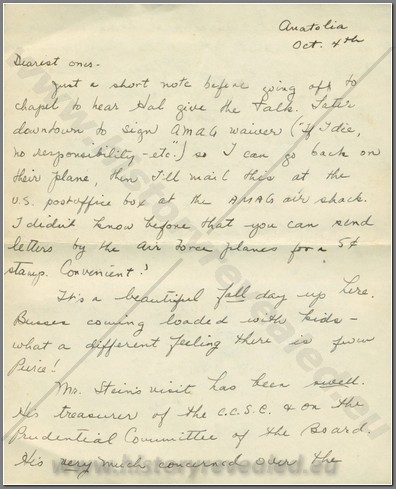
Letter from Elizabeth "Betts", the daughter of missionaries Mr. and Mrs. Harlow to her parents. It is dated Anatolia, October 4. There is no year, but I am estimating it to be late 1940s due to the references to A.M.A.G. (America Mission for Aid to Greece). The text is as follows:
Dearest ones-
Just a short note before going off to chapel to hear Hal give the talk. Later downtown to sign AMAG (American Mission for Aid to Greece) waiver (If I die, no responsibility-etc.") so I can go back on their plane, then I'll mail this at the U.S. post office box at the AMAG air shack. I didn't know before that you can send letters by the Air Force planes for a 5-cent stamp. Convenient?
It's a beautiful fall day up here. Busses coming loaded with kids--what a different feeling there is from Pierce (American College of Greece)!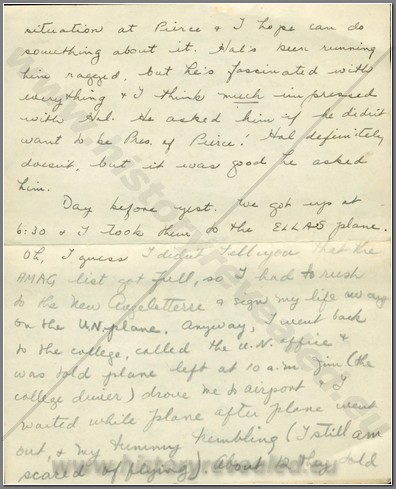 MOB 376
Mr. Stein's visit has been swell. He's treasurer of the C.C.S.C. & on the Prudential Committee of the Board. He's very much concerned over the situation at Pierce & I hope can do something about it. Hal's been running him ragged, but he's fascinated with everything & I think much impressed with Hal. He asked him if he didn't want to be Pres. of Pierce! Hal definitely doesn't, but it was good he asked him.
Day before yest. we got up at 6:30 & I took them to the ELLAS plane. Oh, I guess I didn't tell you that the AMAG list got full, so I had to rush to the New Angeletterre & sign my life away on the U.N. plane. Anyway, I went back to the college, called the U.N. office & was told plane left at 10 a.m. Jim (the college driver) drove me to airport & I waited while plane after plane went out, & my tummy trembling (I still am scared of flying). About 12 they told me the plane wasn't leaving until 4 p.m., so I went back home, had lunch, small nap with Linda, & off to airport again at 3 p.m.
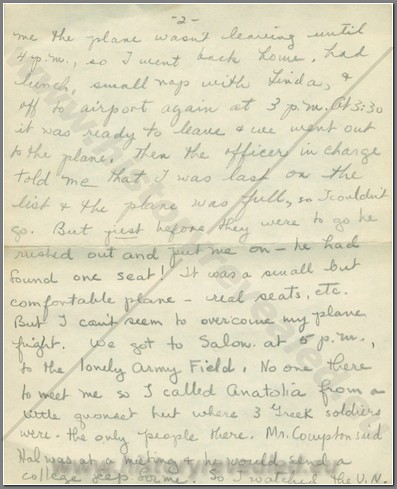 MOB 376At 3:30 it was ready to leave & we went out to the plane, then the officer in charge told me that I was last on the list & the plane was full, so I couldn't go. But just before they were to go he rushed out and put me on--he had found one seat! It was a small but comfortable plane--real seats, etc. But I can't seem to overcome my plan fright. We got to Salon.(?) at 5 p.m., to the lonely Army Field. No one there to meet me so I called Anatolia from a little quonset hut where 3 Greek soldiers were the only people there.
Mr. Compton said Hal was at a meeting & he would send a college jeep for me. So I watched the U.N. people go, talked for 1/2 hr. with one of the Army crew on the plane, watched the crew go, & I was left alone on a huge field with one plane, 1 quonset hut, & 3 Greek soldiers--it was now after 6 p.m. I called Anatolia again--they said Hal had called & was coming. I stayed in the shack with the 3 soldiers, who were really awfully nice--they made me speak Greek, & it was fun, though I was getting worried because time went by & still no one came.
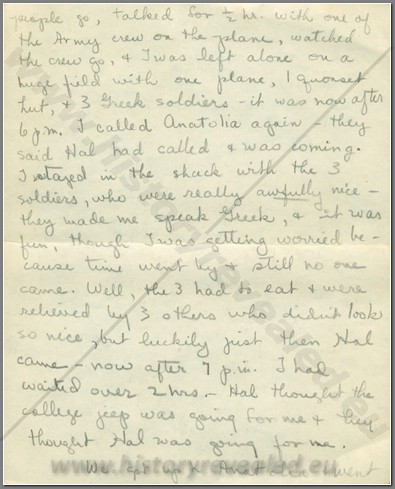 MOB 376Well, the 3 had to eat & were relieved by 3 others who didn't look so nice, but luckily just then Hal came--now after 7 p.m. I had waited over 2 hrs.--Hal thought the college jeep was going for me & they thought Hal was going for me.
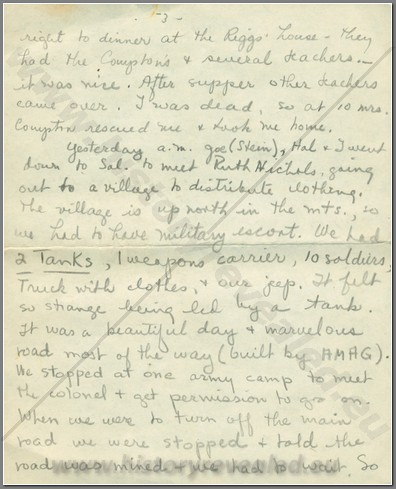
We got up to Anatolia & went right to dinner at the Riggs' house--they had the Compton's & several teachers--it was nice. After supper other teachers came over. I was dead, so at 10 Mrs. Compton rescued me & took me home.
Yesterday a.m. Joe (Stein), Hal & I went down to Sal. to meet Ruth Nichols, going out to a village to distribute clothing. The village is up north in the mts., so we had to have military escort. We had 2 Tanks, 1 weapons carrier, 10 soldiers, Truck with clothes, & our jeep. It felt so strange being led by a tank. It was a beautiful day & marvelous road most of the way (built by AMAG). We stopped at one army camp to meet the colonel & get permission to go on. When we were to turn off the main road we were stopped & told the road was mined & we had to wait. So a truck went ahead of us with a mine detector & we followed. No mines. We passed men along the way guarding the road--civilians. It was lovely country.
(Now at airport waiting for plane)
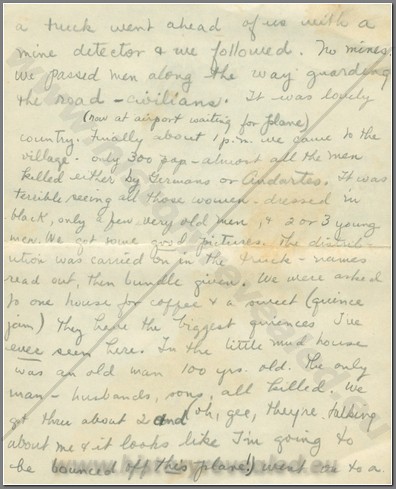
 MOB 376Finally about 1 p.m. we came to the village. Only 300 pop.--almost all the men killed either by Germans or Andartes.(?) It was terrible seeing all those women dressed in black, only a few very old men, & 2 or 3 young men. We got some good pictures. The distribution was carried on in the truck--names read out, then bundle given. We were asked to one house for coffee & a sweet (quince jam) they have the biggest quinces I've ever seen here.
In the little mud house was an old man 100 years old. The only man--husbands, sons, all killed. We got there about 2 and (oh, gee, they're talking about me & it looks like I'm going to be bounced off this plane!) went on to a larger village (Axiopoulos) for dinner. We ate with the soldiers, & after dinner they did Greek dances on the sidewalk & sang. We left about 4, taking turns riding in the tank, & got back at 8:00. Had supper at Comptons & I went to bed right after supper--I was dead!
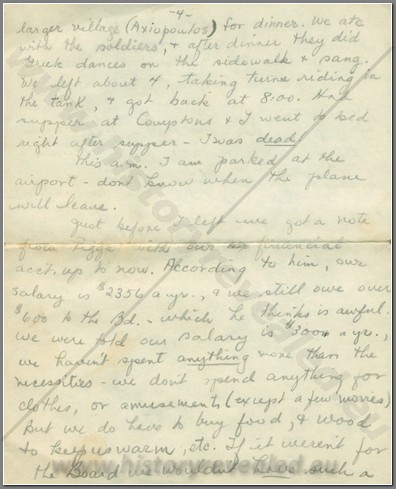
This a.m. I am parked at the airport--don't know when the plane will leave.
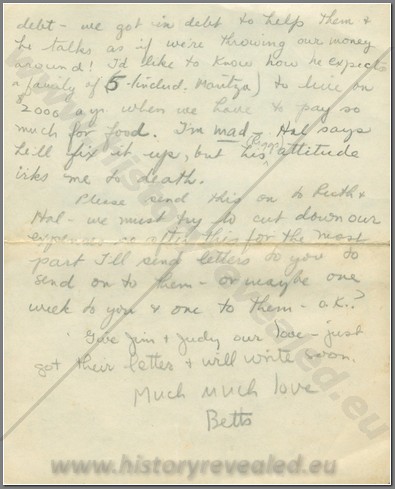
 MOB 376Just before I left we got a note from Riggs with our financial acct. up to now. According to him, our salary if $2356 a yr., & we still owe over $600 to the Bd.--which he thinks is awful. We were told our salary is $3000 a yr., we haven't spent anything more than the necessities--we don't spend anything for clothes, or amusements (except a few movies). But we do have to buy food, & wood to keep us warm, etc. If it weren't for the Board we wouldn't have such a debt--we got in debt to help them & he talks as if we're throwing our money around! I'd like to know how he expects a family of 5 (includ. Maritza) to live on $2000 a year when we have to pay so much for food. I'm mad--Hal says he'll fix it up, but his (Riggs) attitude irk me to death.
Please send this on to Ruth & Hal--we must try to cut down our expenses so after this for the most part I'll send letters to you to send on to them--or maybe one week to you & one to them--O.K.?
Give Jim & Judy our love--just got their letter & will write soon.
Much much love
Betts.
Price: $120.00
 MOB 376NOTE FROM WIKIPEDIA: S. Ralph Harlow (20 July 1885 – 21 August 1972) was an American clergyman and Christian missionary to the Middle East.
Harlow was born in Boston. He graduated from Harvard University in 1908 and from Union Theological Seminary in 1912. He obtained an M.A. from Columbia University and a PhD from Hartford Theological Seminary. He was ordained Congregational minister in 1912 and worked for the American Board of Commissioners for Foreign Missions in Smyrna and Turkey. Harlow was Chaplain and Sociology teacher at the International College in Smyrna from 1912-1922. He worked for the Young Men's Christian Association with the American Expeditionary Force in France until 1922. He was a lecturer for the Carnegie Endowment for International Peace.
 MOB 376He joined the faculty of Smith College faculty in 1923 where he was professor of religion for over thirty years. He was a Socialist candidate for the House of Representatives from Northampton, Massachusetts in 1932. Harlow was a friend of Norman Thomas and advocated for a pacifist philosophy. He was a director of the National Association for the Advancement of Colored People and a member of the American Christian Palestine Committee. He held interest in the paranormal and once claimed to have observed floating angels with his wife. He wrote about psychical phenomena from a Christian perspective and was convinced that there was life after death.
In 1953, the Marion and S. Ralph Harlow Scholarship Fund was established for students. Harlow received an honorary degree of Doctor of Humane Letters from the Hebrew Union College in New York. He was one of the few Christians to be honoured by a Jewish institution. Nelson Glueck commented that Harlow "has actively associated himself with Jewish causes, with Israel and its Hebrew University, and without respect to race and creed, has expended in a humble and perceptive way, a warmth of human sympathy".
Harlow died in Northampton, Massachusetts on 21 August 1972, aged 87. He is buried at Abels Hill Cemetery in Massachusetts.
 MOB 375
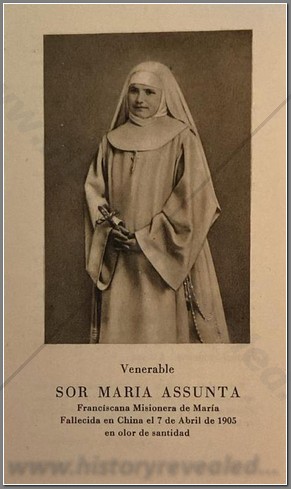
Prayer card for Sister maria Assunto, martyred in China in 1905.
Price: $30.00
 MOB 374
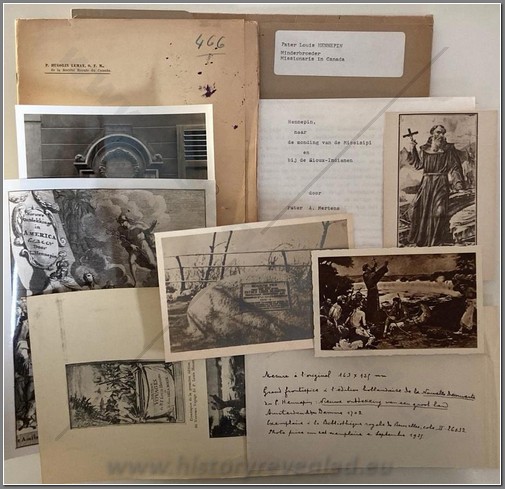
Archive of research conducted by Father A. Mertens on the missionary Louis Hennepin, who is credited with discovering Niagara while accompanying La Salle during his exploration of the western part of New France. There is a 21-page original unpublished manuscript by Mertens titled Hennepin, naar de monding van de missisipi en bij de Sioux-Indianen (Hennepin, to the mouth of the Mississippi and among the Sioux Indians). Also included are photos and a postcard related to Hennepin as well as a 1936 booklet titled Le Pere Louis Hennepin, recollect Son allegiance, politique et religiues, dated 1936. As one of the photos are dated 1950, I assume that this was research that Martens conducted while a seminary student.
Price: $120.00
Note from the Montfort website: Alfons Maria Mertens was born on 8 August 1929 in Bütow (East Prussia). There he spent his childhood and youth, which were overshadowed by the outbreak of war. In the last weeks of the war, he was still called up for military service and was seriously injured by an exploding mine. With his family he came after the war to Cologne. From there, he found his way to our community and was from 1948 to 1952 in the mission school in Reydt. Then he entered the novitiate in Meersen (NL), where he made his first vows on 8 September 1953. From 1953 to 1959 he studied philosophy and theology in the scholasticate of the Congregation in Oirschot (NL). After his graduation, he was ordained a priest on 8 March 1959. His first appointment took him to Bonn, where he gained pastoral experience with a year in the parish of St. Elizabeth, before he was sent to Iceland in 1960. He worked there until 1971, first as the bishop’s secretary, then as Pro-Vicar and Administrator. From 1971 to 1974 he was entrusted with various tasks in Rome. In 1974 he returned to Germany and took on the task of parish-priest in Welschbillig near Trier until, on 24 February 1976, he was elected as the first Provincial of the newly established German province. With much care and commitment, he built up the structure of the province. He held this office until 1986. Thereafter he devoted himself, up to the year 2000, to the support of the Missions in Fremersdorf. In the surrounding parishes of the Saarland, he was a much sought after and welcome supply priest. In 1999, he decided to move into the abandoned monastery of Liebfrauenthal (Our Lady in the Valley) in Wied, where he served until 2007 as ‘rector ecclesiae’. As a retired priest, he spent the years 2007-2011 in Rissenthal. His health became increasingly fragile, so that he had to move into our house in Fremersdorf after a period in hospital in the spring of 2011. More hospitalizations were necessary as his health and strength deteriorated and he became ever more dependent on aid. In April 2013, therefore, he had to move to Dillingen to the St. Francis Home, where he died on May 9, 2013.
 MOB 373
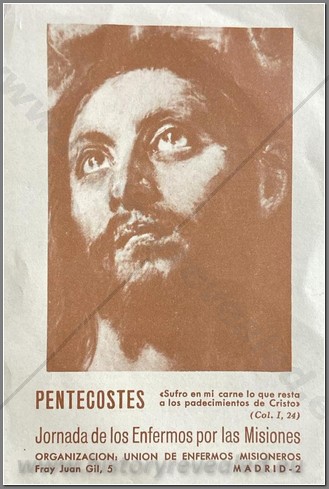
Advert card for the Union de Enfermos Misioneros.
Price: $10.00
 MOB 372
Brochure for the Claretin Missionay Sisters. They operate in Argentina, Colombia, USA, Honduras, Italy, Japan, Mexico, Panama, Venezuela and Zaire.
Price: $30.00
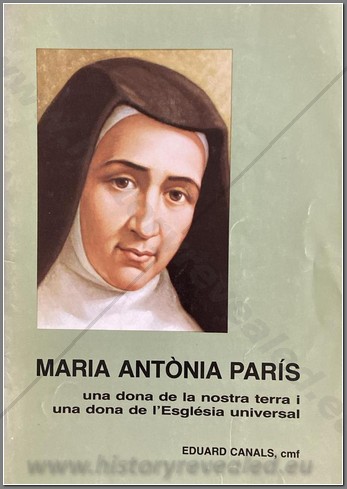 MOB 371
15 page booklet on Maria Antonia Paris (1813-1885). 1985. She was a Spanish Catholic visionary and nun, born in Vallmoll, Spain, who, inspired by mystical experiences of Christ calling for Church renewal, co-founded the Claretin Missionay Sisters in Cuba with St. Anthony Mary Claret in 1855, dedicating her life to education and evangelization, especially for disadvantaged girls, and is now recognized as Venerable by the Catholic Church.
Price: $60.00