Western Americana

t-wa147WA 147

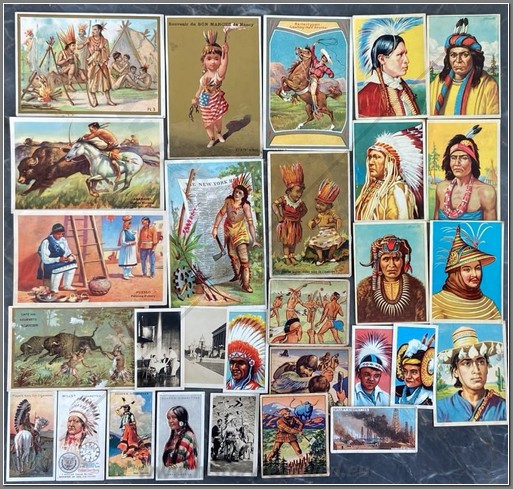
This collection represents a significant and carefully assembled body of European confectionery trade cards portraying the American West, produced primarily between circa 1880 and 1975 by major continental chocolate and confectionery manufacturers. Issued as promotional inserts within consumer packaging, these cards were part of one of the earliest and most influential forms of mass visual marketing, reaching millions of households across Europe. As such, they constitute an important yet under-recognized category of primary source material for the study of visual culture, consumer behavior, and the international circulation of popular historical narratives.

The collection is distinguished by its coherent thematic focus on the American frontier as interpreted through European commercial art. Subjects include Indigenous peoples, cavalry, cowboys, westward expansion, transportation, frontier settlements, and encounters between Native Americans and settlers. These images do not merely depict the American West; they reveal how it was selectively reimagined, mythologized, and commodified for European consumers. The cards therefore document the transnational construction of one of the most enduring frontier myths in modern global consciousness.

From a research perspective, the collection offers exceptional value across multiple academic fields. For scholars of history and American studies, it provides evidence of how narratives of expansion and conquest were disseminated internationally. For researchers in colonial and postcolonial studies, the cards offer critical insight into European systems of representation, racialized imagery, and the normalization of imperial ideologies through everyday consumer objects. For historians of advertising and media, the collection illustrates the sophisticated use of collectible imagery to create emotional engagement, brand loyalty, and repeat consumption. In addition, the cards serve as rich material for the study of chromolithography, commercial illustration, and the evolution of visual storytelling in mass-produced formats.

Importantly, while individual examples of such cards survive, intact and thematically unified collections of this scope and focus are increasingly difficult to assemble. As ephemeral objects originally intended for disposal, their survival in coherent groupings enhances their scholarly and institutional value. Preserved as a collection, rather than as isolated specimens, they allow researchers to examine patterns of representation, serial narrative construction, and marketing strategy in their proper commercial and cultural context.

This collection would therefore constitute a meaningful addition to any university library, special collections department, or research institution seeking to strengthen its holdings in visual culture, advertising history, transnational cultural exchange, and the global reception of the American West. It offers not only compelling visual material but also a rare documentary record of how commercial media shaped historical imagination across national boundaries.

29 cards in total. A handful from US sources but mainly from Europe. Confectioners include Bowman Gum, Will’s Cigarettes, Kavalier, Cavanders, Player’s Cigarettes, Ringtons, Ogden’s Cigarettes, Trebucien, Gordon’s Bread, Au Bon Marche, Chocolat de Guyenne.

Price: $580.00

t-wa146WA 146


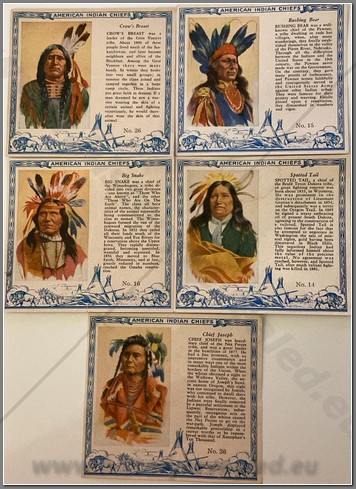
5 cards by Redman Chewing Tobacco issued in 1952 titled American Indian Chiefs. Shown are Crow’s Breast, Big Snake, Rushing Bear, Spotted Tail, Chief Joseph.

Price: $150.00

t-wa145WA 145


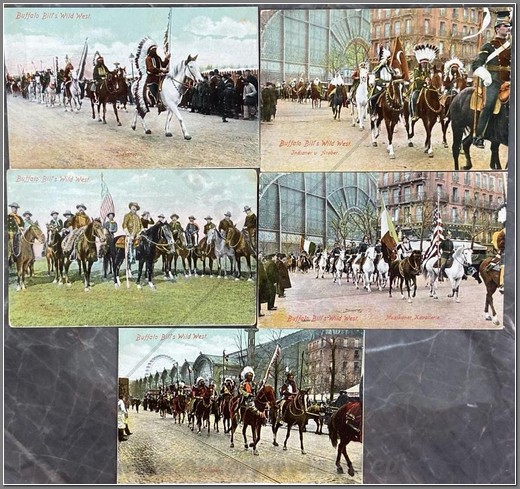
Set of 5 original postcards featuring Buffalo Bill’s Wild West Show in Brussels in 1906. It was part of the last Wild West Show in Europe. AH

Price: $300.00

t-wa144WA 144


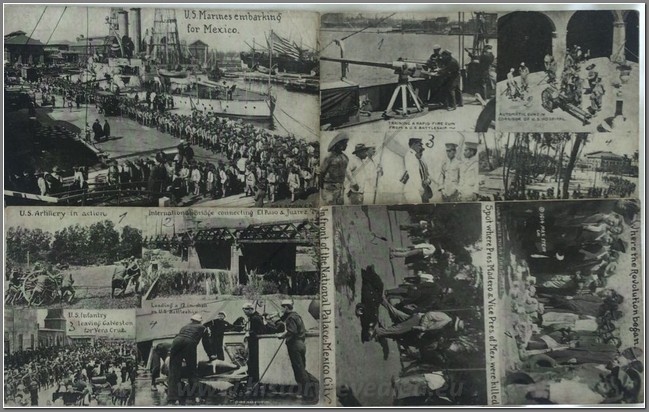
Four period postcards of the 1914 US invasion of Mexico.

Price: $200.00

t-wa143WA 143


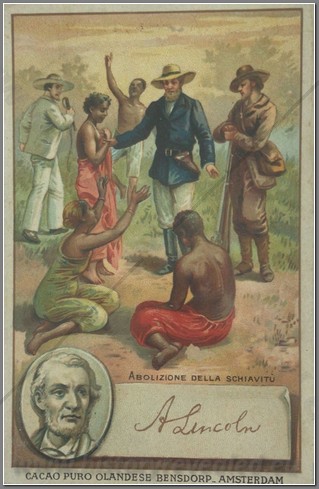
Late 19th century Italian chromo card featuring Abraham Lincoln freeing the slaves. Promoting a dutch confectioner Cacao Bensdorp.

Price: $80.00

t-wa142WA 142

5 photo postcards of the Red Man Spectacle at the 1909 Earl’s Court Exhibition.

Price: $200.00

NOTE: In 1909 at Earl's Court, London, there was The Golden West and American (U.S.A.) industries exhibition, to highlight the progress of 'modern' America and its various industries and products, presumably to encourage trade. One feature of the show was The Red Man Spectacle - a recreation of camp scenes, dancing and warfare, namely the Black Hawk Massacre in Colorado, which seems to be entirely fictitious! Most (all?) of the people who took part were Oglala; many, veterans of trips with Cody, like Red Shirt, Lone Bear and Painted Horse.

t-wa141WA 141

19th century flag of California Republic. Measures 67x88cm.

Price: $1000.00

Note from Wikipedia: The California Republic, or Bear Flag Republic, was an unrecognized breakaway state from Mexico, that for 25 days in 1846 militarily controlled an area north of San Francisco, in and around what is now Sonoma County in California.

In June 1846, thirty-three American immigrants in Alta California who had entered without official permission rebelled against the Mexican department's government. Among their grievances were that they had not been allowed to buy or rent land and had been threatened with expulsion. Mexican officials had been concerned about a coming war with the United States and the growing influx of Americans into California. The rebellion was covertly encouraged by U.S. Army Brevet Captain John C. Frémont, and added to the troubles of the recent outbreak of the Mexican-American War.

The name "California Republic" appeared only on the flag the insurgents raised in Sonoma. It indicated their aspiration of forming a republican government under their control. The rebels elected military officers but no civil structure was ever established. Their flag, featuring a silhouette of a California grizzly bear, became known as the "Bear Flag" and was later the basis for the official state flag of California.

Three weeks later, on July 5, 1846, the Republic's military of 100 to 200 men was subsumed into the California Battalion commanded by Brevet Captain John C. Frémont. The Bear Flag Revolt and whatever remained of the "California Republic" ceased to exist on July 9 when U.S. Navy Lieutenant Joseph Revere raised the United States flag in front of the Sonoma Barracks and sent a second flag to be raised at Sutter's Fort.

t-wa140WA 140


Complete set of 8 early Spanish chromo cards on American aviators. B

Price: $120.00

t-wa139WA 139t-wa139aWA 139


Complete set of 16 Marx Warriors of the World cards on cowboys and indians, produced in 1962. Biography on reverse. B

Price: $990.00

t-cep452CEP 452


Early Mexican comic book on the San Francisco Earthquake.

Price: $90.00

Copyright © 2013-2024 History Revealed