 FA 465
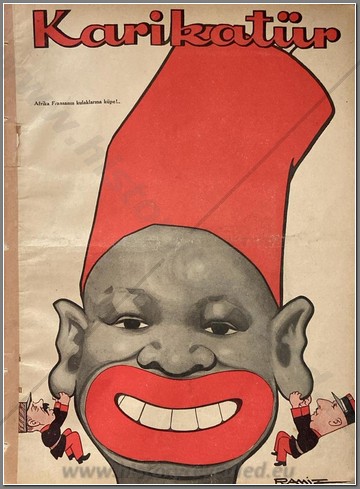
1943 issue of Turkish satirical journal, Karikatur. Cover features the French military hanging onto a Senegalese trailleur. The caption reads “Africa is a lesson for France”. SOLD
Price: $120.00

FA 465
1943 issue of Turkish satirical journal, Karikatur. Cover features the French military hanging onto a Senegalese trailleur. The caption reads “Africa is a lesson for France”. SOLD
Price: $120.00
 FA 464
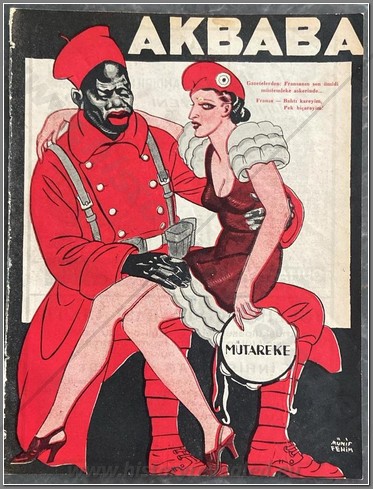
June 4, 1940 issue of Turkish satirical journal, Akbaba. Published just a few weeks before the French surrender. Cover shows France in allegory sitting on the lap of a Senegalese trailleur. Captions read: “From the newspapers: France’s last hope lies in colonial troops……France – I am unlucky, I am utterly helpless”. SOLD
Price: $120.00
 FA 462
 FA 462
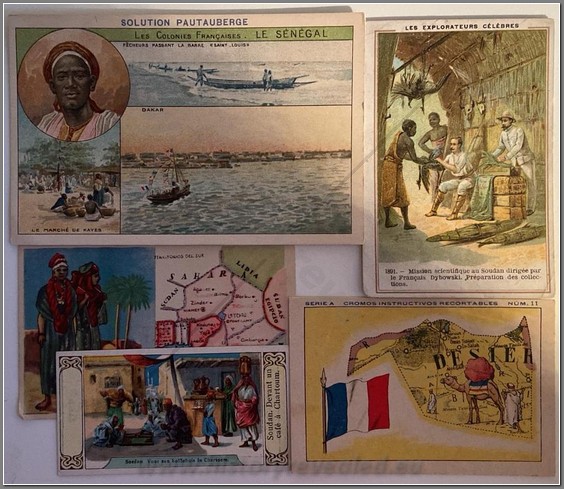
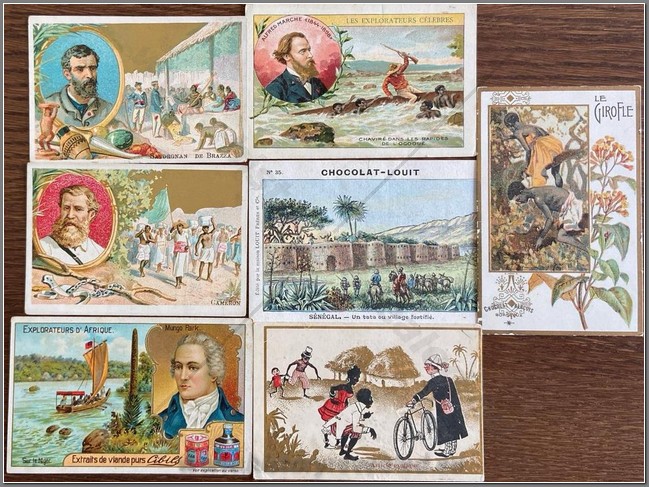
25 early European confectionary cards on French West and Equatorial Africa. Confectioners include Chocolat Martougin, Chocolates Orti, Chocolat Rationnel, Fernandez y Canivell, Soltion Pautauberge, Dentist 142 Rue de Rivoli Paris, Maison Huet, Chocolat-Louit, Arlatte & Co., and some unidentified.
Price: $750.00
 FA 455
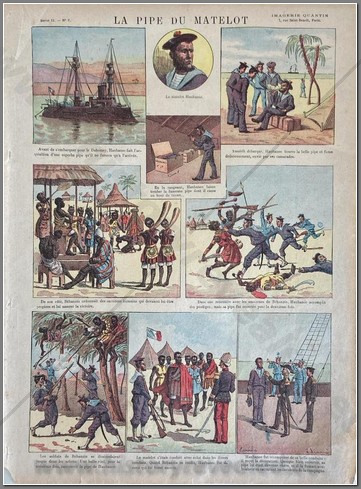
Late 19th/early 20th century Pellerin print by Imagerie D’Epinal. Titled La Pipe du Matelot (The Sailors Pipe). It is about a sailor named Haubanec and his pipe. He participates in the capture of Behanzin, ruler of Dahomey. The last frame reads “Haubanec was rewarded for his fine conduct: he received the decoration. Although his life was much cut short, his pipe had become dear to him, and he smoked it happily while recounting the incidents of the campaign.” SOLD
Price: $200.00
NOTE: The Imagerie d'Épinal ( Vosges ) was originally a printing house founded in 1796 by Jean-Charles Pellerin and where the first images of Épinal were engraved in series. Initially a craft, Epinal imagery gradually became a real industry. The imagery initially used an image engraved in a wooden block ( xylography ). The sheet was then printed using a hand press, called a " Gutenberg ". Then the colorist intervened: using stencils, he applied the different colors necessary to finish the work with a round brush. Around 1850 , the appearance of lithography offered greater possibilities to the artist. Nevertheless, the images of Épinal still represented only 2% of the volume of images peddled in 1860. From 1829 to 1845, the imagery celebrated the Emperor Napoleon Bonaparte, his family, his marshals, his armies and his victories. Under the influence of Rousseauist thought, mid- nineteenth - century society began to see children as consumers. Riddles, dolls to assemble, and soldiers entered the catalog of imagery. At the dawn of the 20th century, the production of imagery was known throughout the world. Puppets, paper theatres, constructions and then, during the First World War , military subjects were all areas where dissemination was significant.
 FA 454
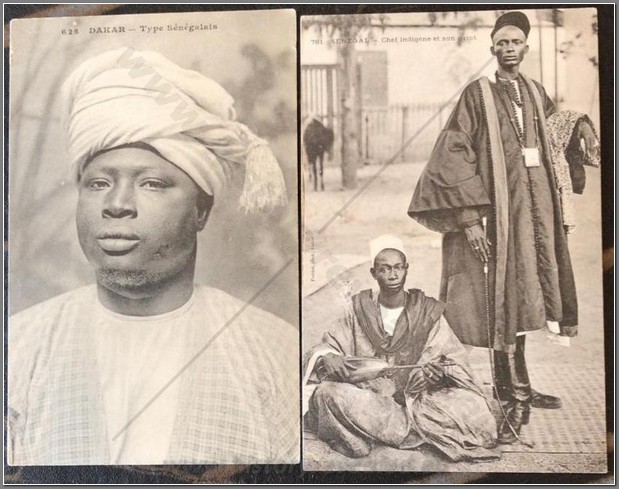
2 colonial postcards of a local Senegalese chief and merchant.
Price: $60.00
 FA 453
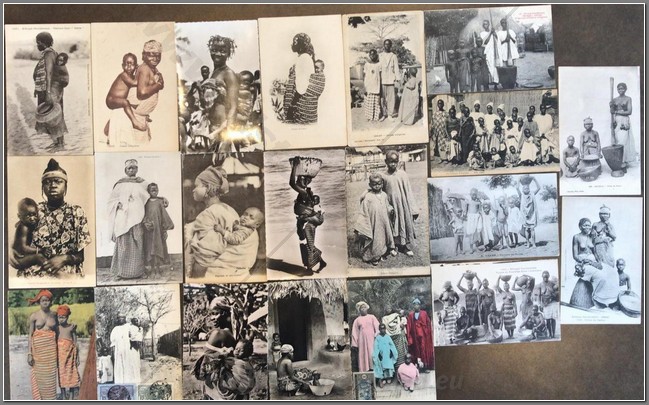
21 French West Africa colonial postcards of mother and child as well as young families.
Price: $630.00
 FA 452
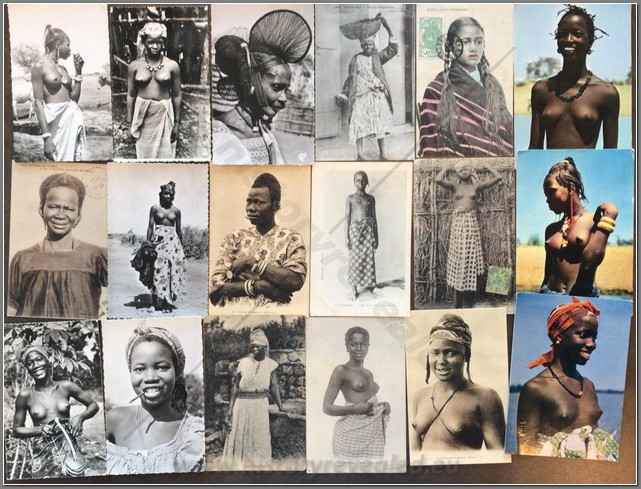
38 colonial postcards of different types of Senegal.
Price: $1140.00
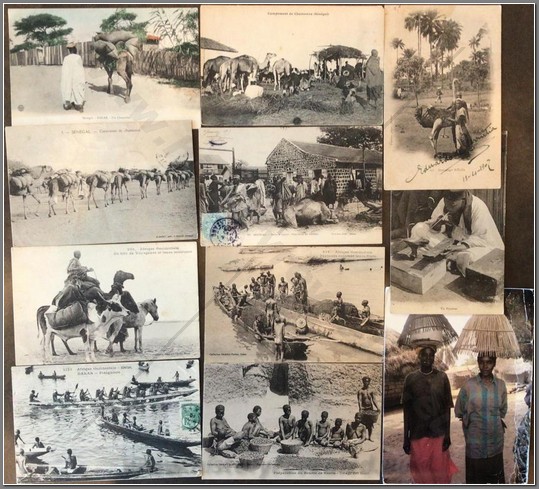 FA 451
11 colonial postcards on the indigenous economy of Senegal. Shown are preparing Karite butter, fishing, camel culture, ostrich handling and a jewler.
Price: $330.00
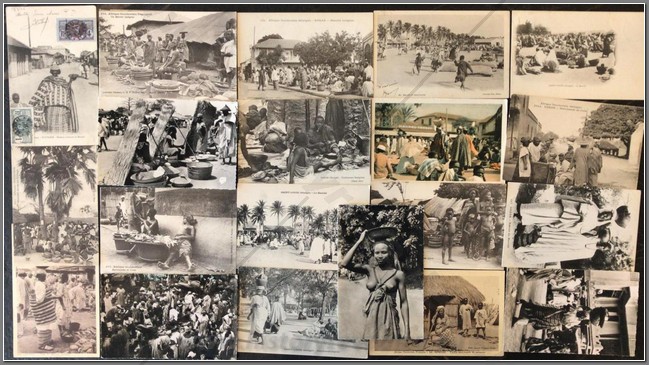 FA 450
21 colonial postcards of different indigenous markets throughout Senegal.
Price: $630.00
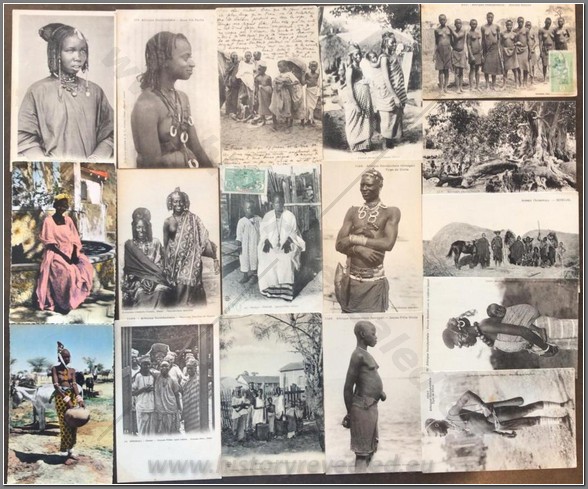 FA 445
17 colonial postcards of the Diola, Peulhs and Lebous people of Senegal.
Price: $510.00