 AFG 177
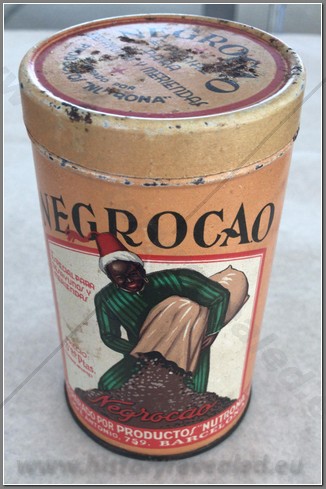
Original can of Negrococao. Spanish, late 19th century. SOLD
Price: $150.00

AFG 177
Original can of Negrococao. Spanish, late 19th century. SOLD
Price: $150.00
 AFG 176
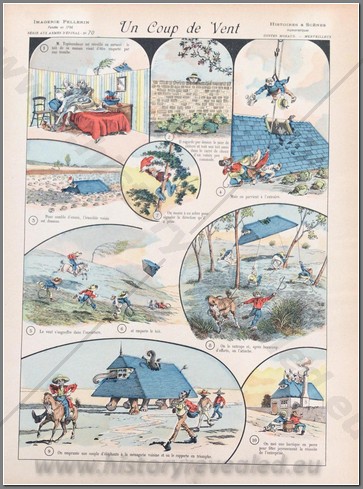
Late 19th/early 20th century Pellerin print by Imagerie D’Epinal. Titled Un Coup de Vent. It shows a group of local natives making off with a rooftop. SOLD
Price: $90.00
Note: The Imagerie d'Épinal ( Vosges ) was originally a printing house founded in 1796 by Jean-Charles Pellerin and where the first images of Épinal were engraved in series. Initially a craft, Epinal imagery gradually became a real industry. The imagery initially used an image engraved in a wooden block ( xylography ). The sheet was then printed using a hand press, called a " Gutenberg ". Then the colorist intervened: using stencils, he applied the different colors necessary to finish the work with a round brush. Around 1850 , the appearance of lithography offered greater possibilities to the artist. Nevertheless, the images of Épinal still represented only 2% of the volume of images peddled in 1860. From 1829 to 1845, the imagery celebrated the Emperor Napoleon Bonaparte, his family, his marshals, his armies and his victories. Under the influence of Rousseauist thought, mid- nineteenth - century society began to see children as consumers. Riddles, dolls to assemble, and soldiers entered the catalog of imagery. At the dawn of the 20th century, the production of imagery was known throughout the world. Puppets, paper theatres, constructions and then, during the First World War , military subjects were all areas where dissemination was significant.
 AFG 175
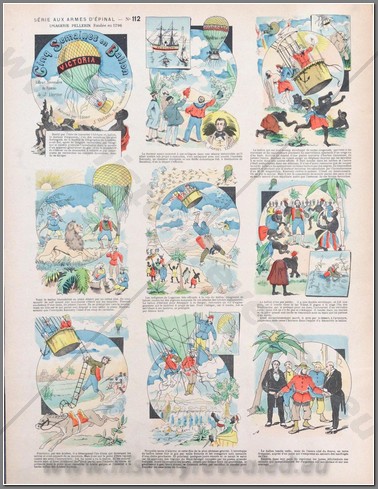
Late 19th/early 20th century Pellerin print by Imagerie D’Epinal. Titled Cinq Semaines en Balloon. It shows a group of balloon travellers landing in Haute-Senegal. SOLD
Price: $90.00
Note: The Imagerie d'Épinal ( Vosges ) was originally a printing house founded in 1796 by Jean-Charles Pellerin and where the first images of Épinal were engraved in series. Initially a craft, Epinal imagery gradually became a real industry. The imagery initially used an image engraved in a wooden block ( xylography ). The sheet was then printed using a hand press, called a " Gutenberg ". Then the colorist intervened: using stencils, he applied the different colors necessary to finish the work with a round brush. Around 1850 , the appearance of lithography offered greater possibilities to the artist. Nevertheless, the images of Épinal still represented only 2% of the volume of images peddled in 1860. From 1829 to 1845, the imagery celebrated the Emperor Napoleon Bonaparte, his family, his marshals, his armies and his victories. Under the influence of Rousseauist thought, mid- nineteenth - century society began to see children as consumers. Riddles, dolls to assemble, and soldiers entered the catalog of imagery. At the dawn of the 20th century, the production of imagery was known throughout the world. Puppets, paper theatres, constructions and then, during the First World War , military subjects were all areas where dissemination was significant.
 AFG 174
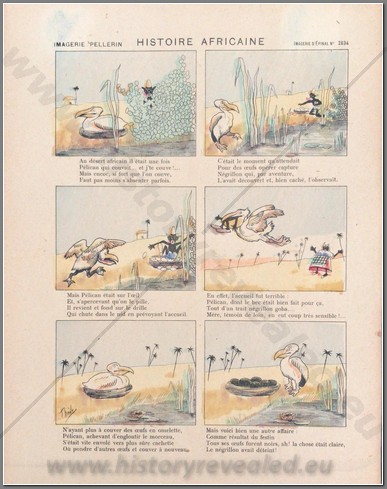
Late 19th/early 20th century Pellerin print by Imagerie D’Epinal. Titled Histoire Africaine, it shows a Pelican laying black eggs after they had been sat on by a negro. SOLD
Price: $90.00
Note: The Imagerie d'Épinal ( Vosges ) was originally a printing house founded in 1796 by Jean-Charles Pellerin and where the first images of Épinal were engraved in series. Initially a craft, Epinal imagery gradually became a real industry. The imagery initially used an image engraved in a wooden block ( xylography ). The sheet was then printed using a hand press, called a " Gutenberg ". Then the colorist intervened: using stencils, he applied the different colors necessary to finish the work with a round brush. Around 1850 , the appearance of lithography offered greater possibilities to the artist. Nevertheless, the images of Épinal still represented only 2% of the volume of images peddled in 1860. From 1829 to 1845, the imagery celebrated the Emperor Napoleon Bonaparte, his family, his marshals, his armies and his victories. Under the influence of Rousseauist thought, mid- nineteenth - century society began to see children as consumers. Riddles, dolls to assemble, and soldiers entered the catalog of imagery. At the dawn of the 20th century, the production of imagery was known throughout the world. Puppets, paper theatres, constructions and then, during the First World War , military subjects were all areas where dissemination was significant.
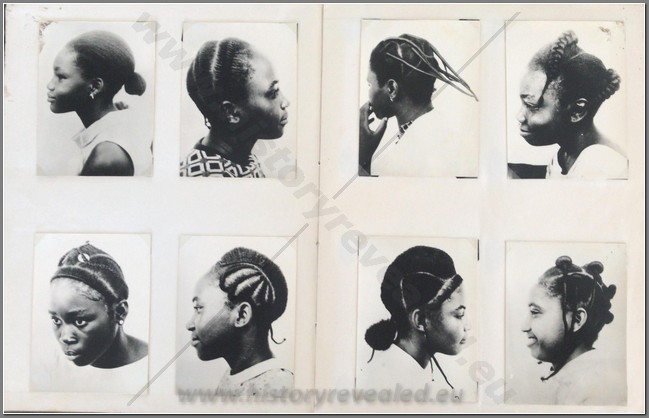 AFG 173
47 photos of African hairstyles, c1950. SOLD
Price: $400.00
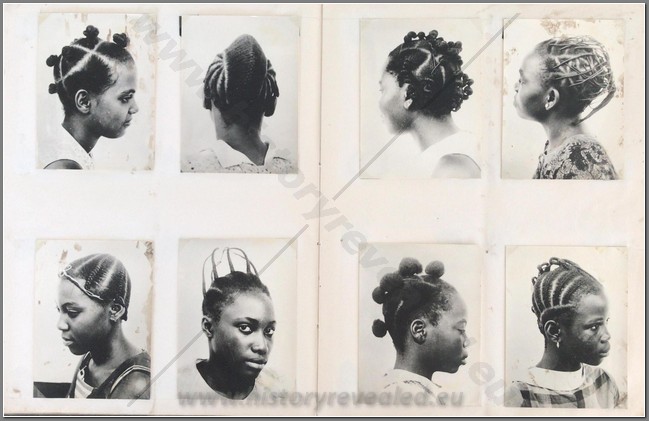 AFG 173 AFG 173 | 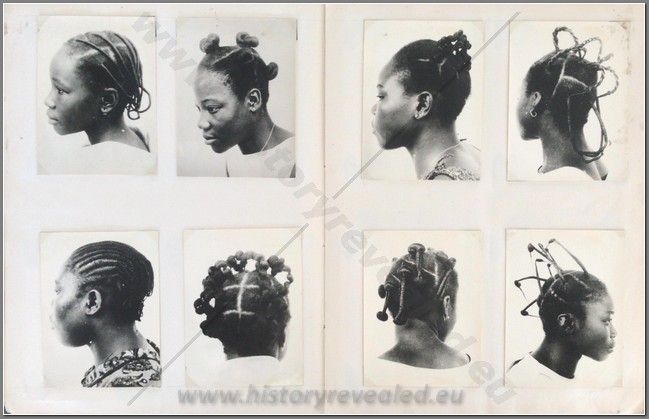 AFG 173 AFG 173 | 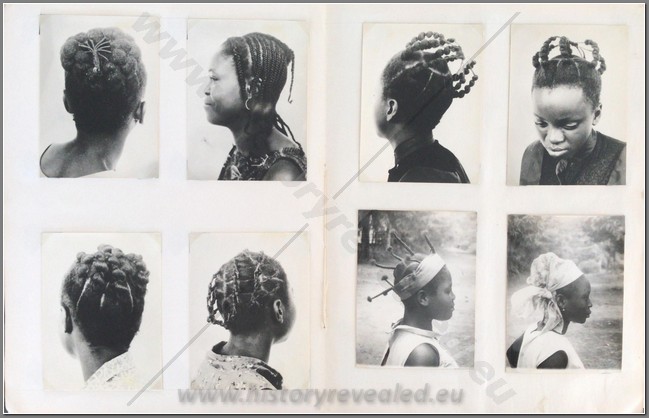 AFG 173 AFG 173 |
 AFG 170
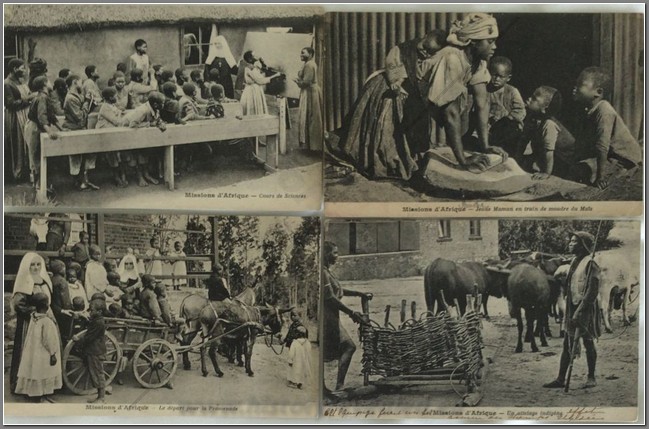
4 colonial postcards of missionary activity in Central Africa.
Price: $100.00
 AFG 168
Collection of 10 colonial postcards of missionary activity, primarily in equatorial Africa.
Price: $200.00
 AFG 159
 AFG 159
Two 1910 French postcards of albino negroes. One is shown with her family. B SOLD
Price: $100.00
 AFG 158
L’armee D’afrique 1830-1930. Son Evolution – Ses Uniformes. Commissariat General du Centenaire de L’Algerie. No major American library holds this. SOLD
Price: $120.00
 AFG 157French stock certificate Societe Coloniale Agricole et Miniere SCAM. SOLD
Price: $70.00
Note: Public limited company with capital of 49,500,000 francs, divided into 495,000 shares of 100 fr. Each. Statutes deposited in the study of Me Prudhomme and Me Ader, notaries in Paris. BEARER SHARES OF 100 FRANCS. Head office: Paris, 73, boulevard Haussmann. Such. : ANJ. 54-43. Incorporation: Public limited company incorporated on April 26, 1923 for a period of 99 years. Purpose: The study, purchase, sale, rental, development, administration and exploitation of all land, all research, prospecting and exploitation of mines, obtaining all concessions in Morocco, in South Oran and in all countries. Share capital: 128,137,800 fr., divided into 1,281,378 shares of 100 fr. Originally, 4,500,000 fr. Increased in 1949 to 19,500,000 fr. per issue at 120 fr. of 450,000 new shares of 100 fr. (10 to 1), then in 1950 to 71,670,000 fr. Increased in 1952 to 85,425,200 fr. by issuing 137,552 new shares of 100 fr. Increased in 1955 to 128,137,800 fr. per issue at 110 fr. of 427,126 shares of 100 fr.