Spanish Civil War /History
SCW 230
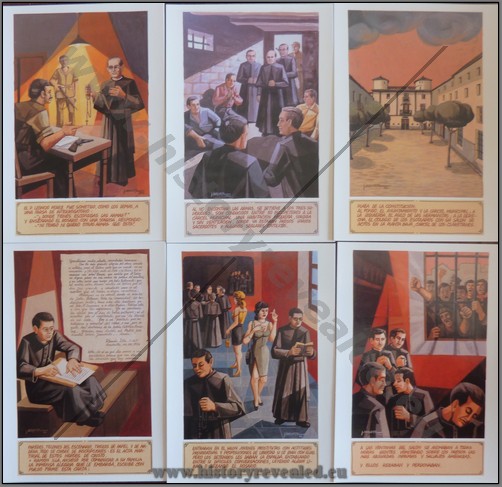
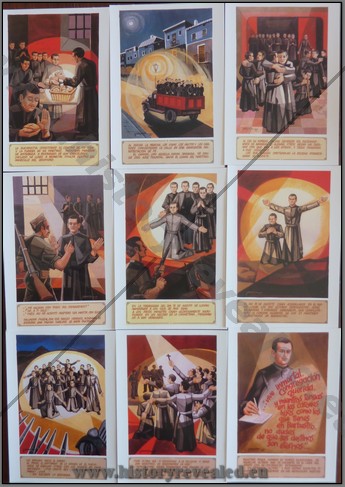
SCW 230Complete set of 10 Spanish chromos on the life of Raymond Lull. M
Price: $200.00
Note: Raymond Lull (1232-1315) was a philosopher, logician, Franciscan tertiary and Majorcan writer. He is credited with writing the first major work of Catalan literature. Recently surfaced manuscripts show his work to have predated by several centuries prominent work on elections theory. He is also considered a pioneer of computation theory, especially given his influence on Leibniz. Lull was born at Palma in Majorca. Through family connections and his own ability he began a career as a courtier, first at the court of King James I of Aragon and then at the court of King James II of Majorca. Lull's love of poetry seems to date from this period, when he came under the influence of the troubadour tradition. In 1263 he experienced a religious conversion. He left his wife (whom he had married in 1256), and began the study of Arabic and philosophy with the intention of helping to convert Moslems to Christianity and fighting Averroistic tendencies in Western philosophy. Lull's study of philosophy and his religious experience culminated in a vision which he had on Mt. Randa in 1272. In that vision he saw a system for the reduction of all knowledge to a series of basic principles associated with the nature of God. Beginning in 1274, he described his system in a series of works, many of which bear the title The Art. He stressed that certain principles of philosophy and theology (which for Lull could never contradict each other) are self-evident and common to all sciences. By a combination of these principles (represented by symbols or numbers) one could be led to the principles of every science and even to the discovery of new truths. For Lull, this method, especially as it used symbols representative of these basic principles in various combinations to express the basic truths, was an aid for exposition and explanation or a device to aid the memory. It did not constitute a means of deducing the universal truths according to algebraic signs, as it did later for Gottfried Wilhelm von Leibniz.In 1276 Lull founded the College of Miramar in Majorca, which trained men in the study of Arabic and prepared missionaries for service in Islamic lands. He made repeated missionary trips to these lands and also continued writing. Altogether, he wrote some 150 or 200 works in Latin, Arabic, and Catalan on such diverse subjects as theology, philosophy, logic, and poetry. Most of them were apologies for the faith and indicate not only his primary desire to convert the infidel but also his attempt to make philosophy subordinate to theology in order to obtain that goal. The Augustinian elements in his thought are quite strong: his rejection of the concept of creation from eternity and his adoption of the ideas of the universal hylomorphic composition of all creatures, the plurality of substantial forms in man, and the primacy of the will over the intellect. Lull's reputation was so great that he was allowed to teach his system at the University of Paris from 1287 to 1289 without holding a degree in theology. In Paris again, from 1297 to 1299, he lectured against the adoption of pagan concepts by Christian thinkers and, in particular, the total separation of philosophy and theology. In 1298 he wrote a book on the errors of Boethius of Dacia and Siger of Brabant, two of the leading Latin Averroists at Paris, and refuted 219 propositions that had been condemned in Paris in 1277. After missionary activity in Armenia (1302) and Africa (1306), Lull returned to Paris in 1309 and for another 2 years continued his attack on the Latin Averroists, this time on the teaching of Averroës and a contemporary exponent of Averroism, John of Jandun. During this period he wrote 17 tracts against the teaching of the Averroists. In search for more official support for his program, Lull attended the Council of Vienne in 1311, where he presented a petition calling for the prohibition of Averroistic teaching, the beginning of another crusade, a fusion of the military orders, and the creation of a college for the study of Oriental languages. In 1314 he returned to his missionary activity in North Africa, and while preaching in Tunisia he was stoned by a crowd at Bougie and later died aboard a ship that had rescued him. His mutilated body returned to Majorca on that same ship.
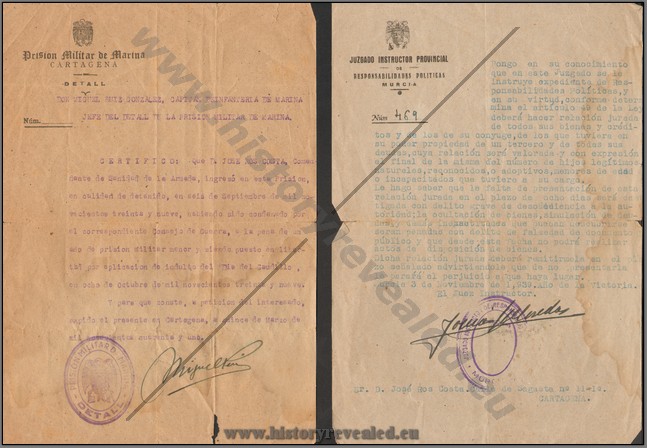
Three court documents relating to a doctor who served in the Republican Navy. His name was Dr. Jose Ros Costa. The first document, dated November 3, 1939, is the notice for him to go to trial. The second document, dated February 5, 1940 is the notice of the amount of time he has to serve in prison. The third document is the notice that he has been pardoned and let free on a special amnesty day. One document is split in half but easily repaired. M
Price: $190.00
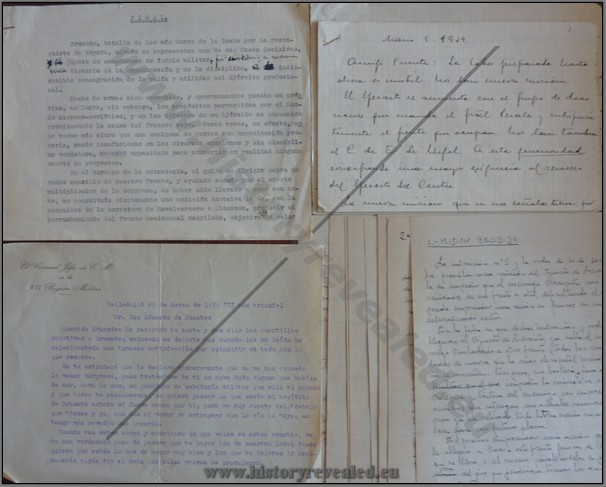
This is a draft of a manual for military operations prepared by Chief Colonel Eduardo Fuentes, of the 7th Military Region in Valadolid, in 1939. He was an officer in a tank division. There are 4 chapters, all written by hand: 1) Receiving a Mission, 2) Examining the terrain, 3) the situation of the enemy, 4) Planning an operation, 5) Execution of the maneuver. There is also a 5 page section entitled FINAL where he talks of a specific battle. Other notes as well. M
Price: $550.00
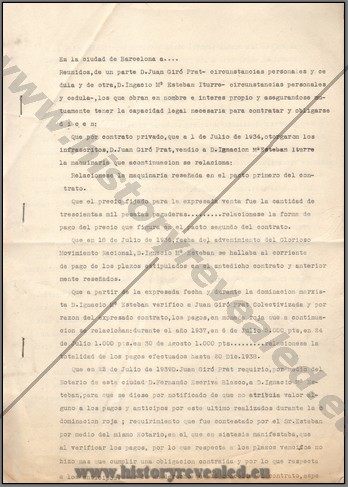
An unusual document. It concerns a machinery purchase made in 1934 by Juan Giro Prat, with payment terms over 6 years. With the fascists now in power, the loan is referred to as “red coin money”, with the obvious communist connection. Loans made before the war had to be converted to the new currency. 90,000 “red” pesetas were now equal to 5,000 pesetas. A 4 page 1940 document. M
Price: $120.00
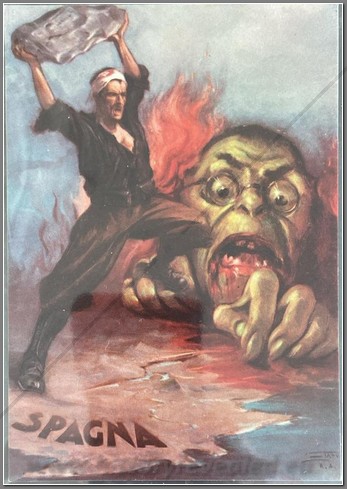
Set of 9 large format Italian anti-communist/pro-fascist propaganda postcards created during the Spanish Civil War by famed Italian fascist artist Boccasile. Rare. M
Price: $1300.00
Note: Gino Boccasile (14 July 1901 – 10 May 1952) was an Italian illustrator. Born in Bari, Boccasile was the son of a perfumer. Early in his youth he lost his left eye, when a drop of quicklime fell into it while he drank from a fountain. Nonetheless, he showed a precocious aptitude for design and completed studies at the fine art school of his home town. After the death of his father in 1925, he moved to Milan. Despite some initial difficulties, he eventually gained a post at the Mauzan-Morzenti Agency. Over the next few years he produced posters, illustrated fashion magazines and gained fame for his sensuous renderings of the female form. Following the lead of fellow poster artist Achille Mauzan, Boccasile went to Buenos Aires, where he met his future spouse Alma Corsi. In 1932 he moved to Paris, where an issue of “Paris Tabou” was dedicated to his work. He also participated in the Salon des Indépendants, that same year. Shortly after returning to Milan, he opened a publicity agency called ACTA, in Galleria del Corso, with his friend Franco Aloi. He illustrated for the Italian periodicals "La Donna" (1932), "Dea" and "La Lettura" (1934), "Bertoldo" (1936), "Il Milione" (1938), "L'Illustrazione del Medico" (1939), "Ecco", "Settebello" and "Il Dramma" (1939) and designed many book covers for Mondadori and Rizzoli.
SCW 179
A supporter of Benito Mussolini, Boccasile produced propaganda material for his government, including several racist and anti-semitic posters. As the tide of war turned against Fascism he became more involved in it, becoming a supporter of the German puppet state, RSI, established by Mussolini in Northern and Central Italy after his liberation from the Gran Sasso exile. Boccasile enlisted in the Italian SS Division, drawing their recruitment posters and illustrating propaganda material. After the war he was imprisoned and tried for collaborating with the fascists. Though acquitted, he remained an outcast. He could not find work for several years as his notoriety was feared by prospective employers. He supported himself briefly by doing pornographic sketches for English and French publishers, and by 1946, after changing his style, Boccasile was back at work. He set up his own agency in Milan where he created memorable posters for Paglieri cosmetics, Chlorodont toothpaste, Iperchina liquors and Zenith footwear. He died in Milan, from bronchitis and pleurisy, in 1952.