 SCW 431
Poster from the Spanish Civil War. It is a prayer about how God is on the side of the Nationalists and will help them. Size 50x39cm. M
Price: $500.00

SCW 431
Poster from the Spanish Civil War. It is a prayer about how God is on the side of the Nationalists and will help them. Size 50x39cm. M
Price: $500.00
 SCW 426
Auca titled “ Auca de la Llutta I Del Milicia”, or, Auca of the Fighting Militia. It discusses how the Civil War started and that the young people want to fight and are willing to die fighting fascism. It warns of having to be careful of fascist spies. Frame 33 shows a rain of airplanes paid by the criminal patriots (nationalists). Women are fighting at the front line, everyone is fighting together. Workers are not slaves and are free, glory to the new heroes who have brought us a new way of living and a new sun. Written in Catalan and published by the Comissariat de Propaganda de la Generalitat de Catalunya. M AH
Note: An auca is a graphic format popular in Spain and especially in the region of Catalonia around Barcelona. The genre dates at least to the 17th century but was banned during the 18th century before experiencing a renewal during the 19th and later the 20th centuries as a uniquely Catalonian form of expression. It takes the form of a cartoon or a comic strip, typically with 48 blocks of image and text, although some may have less. An auca is generally produced as a single sheet, but occasionally a booklet form is used. The captions tend to have some sort of consistent rhyme to assist with the flow and storytelling. Many times the term “auca” appears in the title, but another term, “aleluya,” is used, apparently interchangeably. Some sources indicate that the aleluya originated in Castile and originally included religious elements that were shed over time. Auca was a very popular form of anti-Nationalist propaganda during the Civil War.
Price: $600.00
 SCW 422
Auca titled “Aleluyas sin Censura de la Vida un Poco Dura con Macula y con Borron de un Soberano Borbon”. It is critical of King Alfonso XIII. It discusses the development of his life. Baptised and crowned, Cuba was his first shock, he was happy to be in Paris, victim of terrorism, married an English princess, there was an explosion at the wedding, neutrality in WW1. His soldiers go to Morocco and are starving and ill equipped while he plays polo. His party is elected to power even though the people paid 11 million pts to the royal family. In Melila the victories are more notorious each time while the Bourbons continue to win sailing cups. He goes hunting while the Morocco swallows cannons, arms and men. Primo de Rivera wants to create a coup to restructure everything. If the public disagrees with the king they are taken away. The King and the military look after each other but in the end the King is alone. Sanchez Guerra goes against him, the King takes his money to London. Any dissenters go to prison, the military is not happy, Macia and Zamora see the Republic coming. In the end not even the Civil Guard protect him and has to leave the country. M
Note: An auca is a graphic format popular in Spain and especially in the region of Catalonia around Barcelona. The genre dates at least to the 17th century but was banned during the 18th century before experiencing a renewal during the 19th and later the 20th centuries as a uniquely Catalonian form of expression. It takes the form of a cartoon or a comic strip, typically with 48 blocks of image and text, although some may have less. An auca is generally produced as a single sheet, but occasionally a booklet form is used. The captions tend to have some sort of consistent rhyme to assist with the flow and storytelling. Many times the term “auca” appears in the title, but another term, “aleluya,” is used, apparently interchangeably. Some sources indicate that the aleluya originated in Castile and originally included religious elements that were shed over time. Auca was a very popular form of anti-Nationalist propaganda during the Civil War.
Price: $600.00
 SCW 420
AUCA titled “Como el Fascio se Derrumba Frente al Valor Espanol, o de la Cuna a la Tumba” which loosely translates to “The Fascists Collapse in Front of Spanish Values, or the Cradle to the Tomb”. It is a comment on fascism imported from Italy and Germany, showing how it was practiced in Ethiopia by the Italians and then came to Spain, along with Nazism. In the end though fascism will be defeated in Spain. m AH
Note: An auca is a graphic format popular in Spain and especially in the region of Catalonia around Barcelona. The genre dates at least to the 17th century but was banned during the 18th century before experiencing a renewal during the 19th and later the 20th centuries as a uniquely Catalonian form of expression. It takes the form of a cartoon or a comic strip, typically with 48 blocks of image and text, although some may have less. An auca is generally produced as a single sheet, but occasionally a booklet form is used. The captions tend to have some sort of consistent rhyme to assist with the flow and storytelling. Many times the term “auca” appears in the title, but another term, “aleluya,” is used, apparently interchangeably. Some sources indicate that the aleluya originated in Castile and originally included religious elements that were shed over time. Auca was a very popular form of anti-Nationalist propaganda during the Civil War.
Price: $600.00
 SCW 412
 SCW 412
Two manuscripts from an Italian soldier that fought at Guadalahara and Santander. Typed. One is 25 pages, the other is 12 pages. He must have gone on to fight in Russia with the Azul Division because there are 2 pages devoted to Russia. He writes in prose with nothing that appears to be a daily entry. I suspect he was writing a book as there are also many handwritten edits. M
Price: $600.00
 SCW 408
 SCW 408
First issue of Vertice, April 1937. M AH
Price: $400.00
 SCW 079
Catalan poem entitled “It Will Pass!”, showing a soldier from World War 1 and a Republican soldier in 1936. Size: 23 x 24. M
Price: $120.00
 SCW 406
Fascist poster commemorating fallen martyrs. Size 62 X 44.5 cm. M
Price: $530.00
 SCW 405
September 1934 French press photo of Francoists paying homage to the fallen from the Battle of the Marne. M
Price: $30.00
 SCW 400
Auca published in 1937 in Catalunya. It reads: "De com en Gep i la Rossa van prendre tranquil·lament cafè i copa a Saragossa" How Gep and Rossa drank a cup of coffee in Zaragoza). This auca tells the story of Gep and Rossa, two young workers in love from Catalunya, helping to fight the fascist rebels in the first days of the civil war in Barcelona and then they continue and travel to fight them in Aragón. But then, Gep needs to have a cup of coffee to keep fighting, so he and Rossa decide to enter Zaragoza, a town dominated by fascist-nazi-franco troops, to drink that cup of coffee. So they dress up like moroccans and go to town. When they're having coffee they find themselves in a banquet/feast for military and religious bosses. Gep feels like doing something against then and they end up by changing the cakes for some kind of rubbish so when all the fascists realize what they're eating a big mess happens while Gep and Rossa escape. Size 35x52cm. Good condition. AH
Note: An auca is a graphic format popular in Spain and especially in the region of Catalonia around Barcelona. The genre dates at least to the 17th century but was banned during the 18th century before experiencing a renewal during the 19th and later the 20th centuries as a uniquely Catalonian form of expression. It takes the form of a cartoon or a comic strip, typically with 48 blocks of image and text, although some may have less. An auca is generally produced as a single sheet, but occasionally a booklet form is used. The captions tend to have some sort of consistent rhyme to assist with the flow and storytelling. Many times the term “auca” appears in the title, but another term, “aleluya,” is used, apparently interchangeably. Some sources indicate that the aleluya originated in Castile and originally included religious elements that were shed over time. Auca was a very popular form of anti-Nationalist propaganda during the Civil War.
Price: $600.00
 SCW 404
Prayer card for the 26 martyred catholic priests executed Spain from July 22 to October 23, 1936. Produced in 1989 to commemorate the beatification of one of them (Niceforo Diez Tejerina). M
Price: $20.00
 SCW 377
Commemorative banner celebrating the end of the war. Produced in 1939. Size: 70x74cm. M
Price: $700.00
 SCW 372
 SCW 372
Envelope for an Italian Aviazione Legionaria unit Gruppo Caccia ‘La Cucaracha’. Rare. M
Price: $180.00
 SCW 371
Medal award document for an Italian soldier named Dante Cladini. It was awarded in 1938 by the Spanish Ministero de Defensa Nacional. Original medal with ribbon included. Size 25x36cm. It is rare to find such documents complete with medal for an Italian soldier fighting in Spain. M
Price: $700.00
 SCW 068
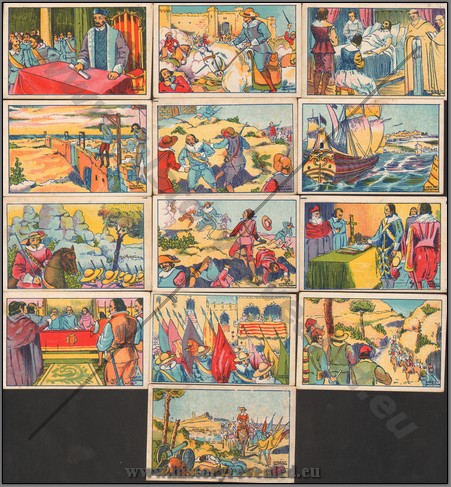 SCW 068
Complete set of 25 Spanish confectionary cards on the subject of the Revolt of the Reapers, 1640-1652. Captioned on back. M
Price: $225.00
 SCW 362
 SCW 362
Complete Spanish chromo set entitled the Conquest of Sicily by the Catalans. M
Price: $350.00
 SCW 357
Special issue of Hoja Oficial commemorating the first anniversary of the “Liberation of Spain”. 12 pages. m
Price: $150.00
 SCW 356
Special issue EL FRENTE DE JUVENTUDES, concerning sports in the Franco regime. Mid 1950’s. M
Price: $150.00
 SCW 353
 SCW 353
A 21 page juvenile bulletin TESON, published in 1948 in Valencia. Very rare. m
Price: $200.00
 SCW 417
AUCA titled “Aleluyas de la Defensa de Euzkadi”. Written in Catalan, it shows the different events of the defense of the Basque country during the Civil War. It shows the children leaving the country (36), the British and French helping the Basques (38-40), the German bombardment of Guernica (33), the sinking of the Spanish destroyer Espana (34), Bilbao on the defensive (44), hoping for help from Aragon (45), the Catalans helping the Basque people (47), may the generals die for being traitors (47). It ends on a high note of the sun rising on free Spanish town. AHKH
Note: An auca is a graphic format popular in Spain and especially in the region of Catalonia around Barcelona. The genre dates at least to the 17th century but was banned during the 18th century before experiencing a renewal during the 19th and later the 20th centuries as a uniquely Catalonian form of expression. It takes the form of a cartoon or a comic strip, typically with 48 blocks of image and text, although some may have less. An auca is generally produced as a single sheet, but occasionally a booklet form is used. The captions tend to have some sort of consistent rhyme to assist with the flow and storytelling. Many times the term “auca” appears in the title, but another term, “aleluya,” is used, apparently interchangeably. Some sources indicate that the aleluya originated in Castile and originally included religious elements that were shed over time. Auca was a very popular form of anti-Nationalist propaganda during the Civil War.
Price: $700.00