France/Italy/UK 20th Century Political Movements

t-epm207EPM 207


Alle Donne d’Italia. Letters and poetry dedicated to the women of Italy. Issued during the fascist period. The phrase "Alle Donne d'Italia" (To the Women of Italy) reflects the propaganda efforts directed toward Italian women during the Fascist regime (1922–1943). Literature, letters, and poetry addressed to women during this era served a dual purpose: reinforcing the regime's ideology while masking systemic oppression. AH

Price: $150.00

t-epm205EPM 205t-epm205aEPM 205t-epm205a1EPM 205t-epm205a2EPM 205


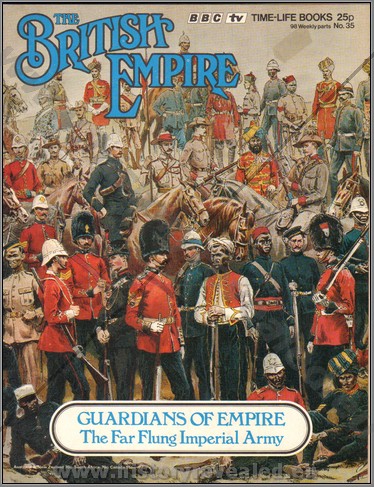
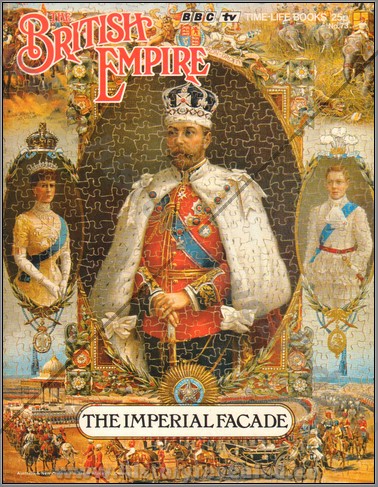
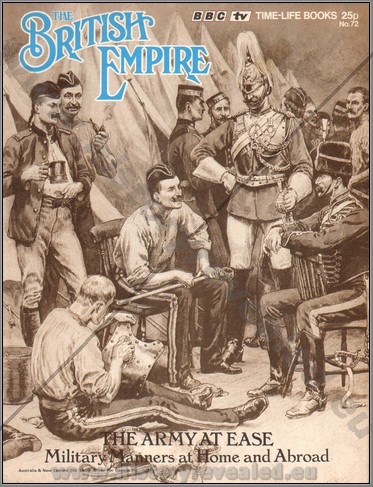
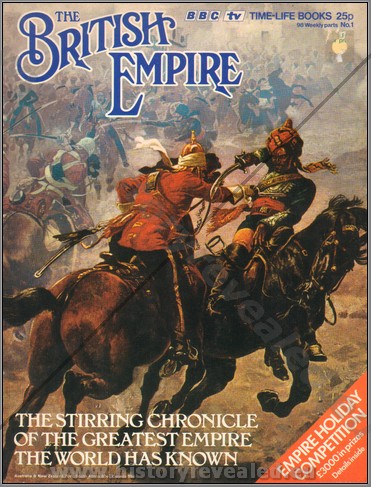
Collection of 4 magazines titled The British Empire, published by BBC TV Time-Life Books, 1972-1973. B

Price: $120.00

t-epm202EPM 202t-epm202aEPM 202


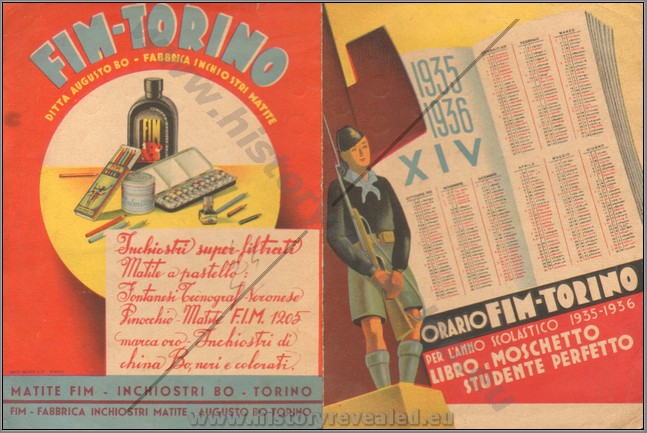
1935-1936 student record of their class schedules. AH

Price: $90.00

t-epm201EPM 201


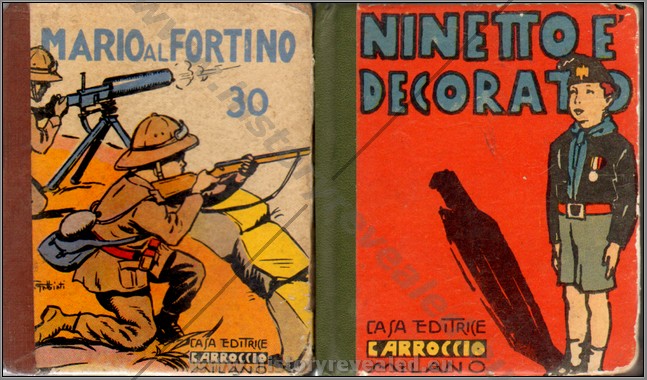
Two childrens books from Bibliotechina Balilla. One is in very good condition, the other in poor condition but complete. It is rare to find these childrens books. m

Price: $200.00

t-epm198EPM 198


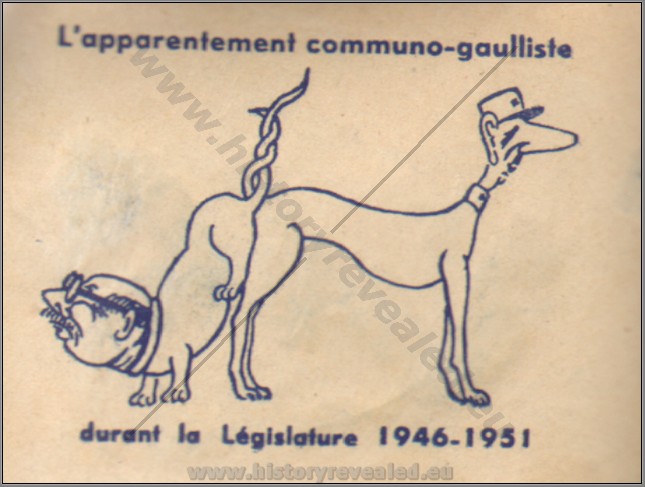
French propaganda leaflet: the Communist-Gaulist agreement, during the 1946-1951 legislature. 

Price: $80.00

t-epm197EPM 197t-epm197aEPM 197


Propaganda booklet. A La Croisee Des Chemins. m

Price: $190.00

t-epm196EPM 196t-epm196aEPM 196


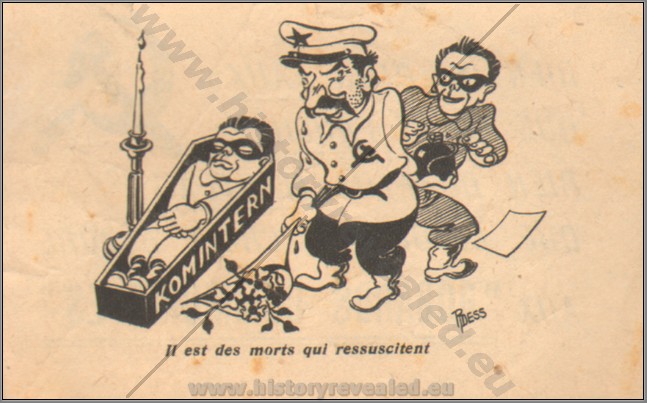
French anti-communist propaganda leaflet. m

Price: $80.00

t-epm194EPM 194


Les Histoires qu’on Racontait Lorsqu’ ils Etaient La, by George Fronval. AH

Price: $150.00

t-epm192EPM 192


Large fold-out issue of Don Pirloncino of the Italian Exposition in Turin, 1884. Size 44x64cm. Fold wear. M

Price: $90.00

t-epm183EPM 183t-epm183a2EPM 183t-epm183aEPM 183t-epm183a1EPM 183

French personal album of caricatures The name of the artist was P. Goutaland. He was a pharmacist living in Charleieu (Loire) and this is his sketch book from 1937. 32 sketches in total, many political. 

Note:  Pierre (or Claudius) Goutaland was a licensed pharmacist who operated in Charlieu (and later in nearby Roanne, Loire). Beyond compounding medicine, Goutaland was an active member of scientific societies in the region (such as the Société Linnéenne de Lyon). Like many educated intellectuals of the Belle Époque, he practiced drawing and caricature as a creative hobby. Because he was a prominent, highly trusted professional in a tight-knit provincial community, his personal albums often depicted local residents, prominent regional figures, and fellow pharmacists of the département de la Loire. Goutaland's caricatures reflect a much broader 19th-century French cultural trend where pharmacists were frequent subjects of, and contributors to, satirical art. In France, the apothecary or pharmacist was viewed as a pillar of the community—making their stores the perfect setting for satirizing local gossip, politics, and the ailments of the French state. During this era, notable artists like Honoré Daumier and J.J. Grandville published famous caricatures focusing on the medical and pharmaceutical professions.

Price: $1000.00

t-epm183a3EPM 183 t-epm183a4EPM 183 t-epm183a5EPM 183 t-epm183a6EPM 183

t-epm180EPM 180


Unpublished manuscript titled Sacrificio – Gloria – Eroismo delle “Berrette Rosse” Pavesi. It is about the early martyrs of fascism in Pavia. They were referred to as “red hats”, made famous by Garibaldi. It contains the authors draft edits. Biographies on each of the fallen, most with accompanying photos. 146 pages of text and photos. 

NOTE: The specific historical events that created the "Fascist Martyrs of Pavia" occurred during the violent agrarian and civil clashes of 1921 and 1922. This period, transitioning from the left-wing uprisings of the Biennio Rosso to the rise of Fascism, turned the Province of Pavia into a major battleground. The specific events that led to these deaths, and how they occurred, are outlined below.

The most notable event directly tied to the Pavia "martyr" designation was the killing of Enea Podestà, a university student and prominent local squadrista (Blackshirt).  On February 19, 1922, intense political clashes broke out in the streets of Pavia between local fascists and socialist railroad workers. Podestà was shot and killed during the skirmish. His death triggered immediate, bloody retaliatory raids by the Pavia squads. Later that same day, local fascists stormed a railway workers' club and beat communist Umberto Bizzoccoli to death. They then drove to the nearby village of San Martino Siccomario and assassinated a socialist mason named Eliseo Davagnini.

The other individuals later canonized as "martyrs" died during offensive "punitive expeditions" launched by Pavia's fascist squads into the surrounding countryside. The agricultural regions surrounding Pavia were highly unionized socialist strongholds. Financed by wealthy local landowners, the Pavia squads routinely loaded into trucks, drove into rural villages, and attacked labor union halls and cooperative socialist offices.  While many of these raids resulted in one-sided violence against unarmed workers, rural socialist and communist peasant leagues occasionally ambushed the incoming trucks or fought back with hunting rifles and farming tools. The fascists killed in these specific counter-attacks were the ones later buried in the Pavia memorial.

In the months leading up to the March on Rome, the local squads aimed to completely paralyze local democratic government bodies. In July 1922, regional fascist squads orchestrated a massive paramilitary occupation of the city of Pavia. They forced the democratically elected socialist municipal government to resign under threat of death and seized public buildings. Gun battles broke out across the city between squadristi, local law enforcement trying to maintain order, and anti-fascist defense blocks. Several squadristi died during this multi-day siege to strip Pavia of its local governance.

Historically, these "martyrs" were not passive victims of religious or political persecution. They were paramilitary combatants killed in active, armed street warfare while attempting to dismantle Italy's left-wing labor movements and democratic institutions by force.

Price: $1200.00

t-epm180aEPM 180 t-epm180a1EPM 180 t-epm180a2EPM 180

t-epm176EPM 176


Set of 5 fantasy postcards drawn by Emille Dupuis in 1916 on major countries, with emphasis on World War 1. Countries include Portugal, Norway, USA, Holland and Spain. M ah

Price: $250.00

t-scw483SCW 483


La Repubblica di Spagna Con Riferimento Alle Cose D’Italia, by Ludovico Zuccoli, Napoli, 1943. No USA library holds this

Price: $90.00

t-epm175EPM 175


Set of 4 cards by Chocolate Aiguebelle on the visit of the Czar of Russia to France in 1891 and 1896. MB ah

Price: $120.00

t-epm172EPM 172t-epm172aEPM 172


Letter and envelope for the Black Shirt 781st Balilla (youth) Legion and invoice from a manufacturer of childrens fascist uniforms. m

Price: $200.00

t-epm166EPM 166t-epm166aEPM 166


Three issues of The Times History and Encylopedia of the War, 1916-1917, All issues dedicated to the war in Persia. B

Price: $120.00

t-epm166a1EPM 166 t-epm166a2EPM 166 t-epm166a3EPM 166 t-epm166a4EPM 166

t-epm165EPM 165


Collection of 20 chromo cards by Chicoree Blue-Argent, Titled La France Formee Par Les Provinces. Early 20 th Century, description on the back. B

Price: $150.00

t-epm165aEPM 165 t-epm165a1EPM 165 t-epm165a2EPM 165 t-epm165a3EPM 165

t-epm163EPM 163t-epm163aEPM 163


Group of 11 large format photos on various Italian fairs during the fascist period. All captioned on reverse. M

Price: $500.00

t-epm163a1EPM 163 t-epm163a2EPM 163 t-epm163a3EPM 163 t-epm163a4EPM 163

t-epm161EPM 1611898 hadwritten letter by Edmondo De Amicis. M

Price: $150.00

Note: From Wikipedia: Edmondo De Amicis (21 October 1846 – 11 March 1908) was an Italian novelist, journalist, poet and short-story writer. His best-known book is Cuore, a children's novel translated into English as Heart. Born in Oneglia, he went to the Military Academy of Modena, and became an Army officer in the new Kingdom of Italy. De Amicis fought in the battle of Custoza during the Third Independence War, a defeat of Savoy forces against the Austrian Empire; the spectacle left him disappointed, and contributed to his later decision to leave military life.

In Florence, he wrote his first sketches dealing with his frontline experience, collected as La Vita militare ("Military Life", 1868), and first published by the journal of the Ministry of Defense, L'Italia Militare. In 1870, he joined the staff of the journal La Nazione in Rome, and his correspondence at the time later served as base for his travel writings: Spagna (1873), Olanda (1874), Ricordi di Londra (1874), Marocco (1876), Costantinopoli (1878), Ricordi di Parigi (1879). A new edition of Costantinopoli, considered by many his masterpiece and the best description of the city in the 19th century, was published in 2005, with a foreword by Umberto Eco. Heart was issued by Treves on 17 October 1886, the first day of school in Italy. Its success was immense: in a few months it was printed in 40 Italian editions and translated into dozens of languages. Its praise for the creation of the united Italian state in the previous decade contributed to its reception, but also led to criticism from some Roman Catholic politicians for failing to depict the nature of the Holy See's opposition to the annexation of Rome. The nationalist message visible in De Amicis' works was soon fused with a commitment to socialism (a trend visible within Heart). In 1896, he joined the Italian Socialist Party. He was elected a Foreign Honorary Member of the American Academy of Arts and Sciences in 1901.

His later works include: Sull'oceano (1889), dealing with the plight of Italian emigrants overseas, Il romanzo di un maestro (1890), Amore e ginnastica (1892), Maestrina degli operai(1895), La carrozza di tutti (1899), L'idioma gentile (1905), and Nuovi ritratti letterari e artistici (1908). At the same time, he contributed to the Turin-based Il Grido del Popolo - his articles were collected as Questione sociale ("Social Issues", 1894). De Amicis died in Bordighera at the "Hotel de la Reine", which he choose because it was George MacDonald's Casa Coraggio, Bordighera. His last years were marked by tragedy and spent in reclusion; he was marked by his mother's death, and the frequent conflicts with his wife - ultimately, these were the source of an even greater emotional shock for De Amicis, as they led to his son Furio's suicide (as schoolchildren, Furio and his brother Ugo had served as inspiration for Heart).

Yes and no ballots to approve the deputies designated by the Grand Council of Fascim for the XXVIII Legislature (1929). 

NOTE: The Grand Council of Fascism was the highest constitutional and decision-making body of Benito Mussolini's regime in Italy. In 1929—corresponding to the XXVIII Italian legislative term—the Grand Council transformed from a private party committee into an official state institution and oversaw major political, electoral, and legislative changes. It was given the power to draft the single national list of 400 candidates for the 1929 parliamentary elections. Voters could only vote "Yes" or "No" to approve the Council's pre-selected list. Through a law passed in December 1929, the National Fascist Party became a permanent institution in the state, with the Grand Council dictating its statutes and policies. The Council controlled all regime activities, including foreign policy, labor unions, and the suppression of political opposition. The Grand Council allowed Mussolini to consolidate absolute control while maintaining the facade of an organized, legal government. However, this centralization laid the groundwork for his eventual removal. In July 1943, when Italy faced catastrophic defeats in World War II, this exact same Council passed a vote of no confidence against Mussolini, triggering the collapse of the Fascist regime.

Price: $200.00

t-epm155EPM 155 t-epm155aEPM 155 t-epm155bEPM 155 t-epm155cEPM 155

Copyright © 2013-2024 History Revealed