France/Italy/UK 20th Century Political Movements

t-epm153EPM 153t-epm153aEPM 153


Collection of 23 commercial photos of Italian nobility and senior political and military personnel. Shown are Mussolini, the King and Queen, Badoglio, Graziani, Marconi, Umberto, Principe and Principessa di Piemonte, Starace. M

Price: $100.00

t-epm152EPM 152


Photo postcard of the Duca d’Aosta in 1928. M

Price: $20.00

t-epm148EPM 148


5 fascist period perfumed calendars, featuring colonial/imperial/fascist themes. ASK FOR AVAILABILITY

Price: $1000.00

t-epm145EPM 145


1940 calendar for the Cassa di Risparmio di Parma. Complete.

NOTE: Cassa di Risparmio di Parma (historically known as Cariparma) was the oldest and most influential bank in the city of Parma, Italy. Today, it operates as part of Crédit Agricole Italia.  It was originally established in December 1859 under the rule of Marie Louise, Archduchess of Austria, to foster local economic development.  The bank grew by financing local artisans, manufacturing, and agricultural projects. It was highly instrumental in funding the food processing industry that still defines the economy of the Parma region today. For over a century, the bank used an image of a bee as its primary emblem to symbolize thriftiness, hard work, and savings. In 1937, the bank shifted toward modern administration by installing a cutting-edge electro-mechanical accounting unit equipped with early Hollerith calculators. Following the global financial crisis of 1929, the bank heavily increased its capital layout into agricultural funding starting in 1933. By 1940, the outbreak of World War II dramatically shifted Italian banking toward supporting wartime economies, heavily restricting normal international financial contacts and eventually placing many regional banks under tighter state controls. Following the Italian banking reform (the Amato Law of 1990), the bank was split into two entities in 1991: the corporate banking enterprise (Cassa di Risparmio di Parma S.p.A.) and Fondazione Cariparma, a non-profit foundation dedicated to local social and cultural development. In 2007, the French banking giant Crédit Agricole Group acquired the bank, expanding its name to Cariparma Crédit Agricole. In 2016, the historical "Cariparma" branding was retired and consolidated alongside sister regional banks into the unified corporate identity of Crédit Agricole Italia, which now stands as one of the largest banking networks in Italy.

Price: $250.00

t-epm144EPM 144


Visioni di Roa Imperiale. Published by the Ente Nazionale per le Industrie Turistiche and the Ferrovie dello Stato, 1937. M

Price: $150.00

t-epm140EPM 140


1933 silver medal award to a sixth grade student for his performance. Size: 38 x 54cm. M

Price: $450.00

t-epm132EPM 132t-epm132aEPM 132


Official 20 page brochure for the 1939 Fiera di Tripoli. 

NOTE: The 13th Tripoli International Fair (also known as the Trade Fair) took place in Libya starting from 12 April 1939. Founded in 1927 as the first trade fair in Africa, the 1939 event was the last before the outbreak of World War II and is today remembered primarily for its prestigious series of commemorative stamps. The fair was a prestigious showcase for the Italian Empire, featuring enormous pavilions dedicated to agriculture, industry, and major national companies. From a historical and collectors' perspective, the 1939 event is famous for: Philatelic Issue: The Italian postal administration issued two distinct series of commemorative stamps, Architecture and Pavilions: The fair body occupied an architectural complex in Moorish and rational style designed by the architect Florestano Di Fausto, where Italian companies (such as Breda) and agricultural consortia exhibited their innovations, End of the era: With the escalation of international tensions in 1939 and Italy's subsequent entry into the war in 1940, the fair underwent a long interruption and never returned to the glories of that colonial period.


Price: $150.00

t-epm129EPM 129


Interesting brochure showing the battlefields of Gorizia. It is a fascist brochure focusing on World War battles. However, Gorizia was also the scene of the first action of the Germans in Italy following the Italian armistice. The battle was fought from September 11-26, 1943. 

NOTE: Gorizia was one of the most significant and fiercely contested locations on the Italian Front during World War I. For over a year, the Italian army launched repeated, bloody offensives trying to capture Gorizia, which was protected by rugged, heavily fortified terrain.  During the Sixth Battle of the Isonzo (August 1916), Italian forces successfully seized the strategic heights of Mount Sabotin and Mount San Michele. This forced the Austro-Hungarian army to retreat and allowed Italian troops to occupy the city. This was Italy's first major victory of the war, and hence its value as a propaganda tool for the fascists, shown here.

Price: $90.00

t-epm125EPM 125t-epm125aEPM 125


1941 safety propaganda calendar booklet 365 Giorni Senza Infortuni! (365 Days Without Accidents). 

Price: $120.00

t-epm124EPM 124t-epm124aEPM 124


The 1943 Safety Propaganda Calendar Booklet was produced by the Ente Nazionale di Propaganda per la Prevenzione degli Infortuni (ENPI), the Italian national organization dedicated to workplace safety and hygiene. It utilized striking futurist- and constructivist-style illustrations to encourage industrial and agricultural accident prevention during World War II.  The booklets served as educational tools aimed at reducing workplace injuries in wartime Italy, emphasizing safe machinery operation and the use of early personal protective equipment (PPE). ENPI’s visual campaigns were known for employing bold typography, vibrant colors, and dramatic, heroic imagery of workers combined with stark reminders of the consequences of workplace negligence.

The 1943 period marked a pivotal year for the institute, as its official publication (the Rassegna della sicurezza e dell'igiene del lavoro) suspended issues from mid-1943 until after the war.

Original physical copies of this specific calendar are extremely rare historical ephemera. They rarely appear in public commercial markets and are primarily preserved within specialized Italian historical and labor archives.

Price: $180.00

t-epm122EPM 122t-epm122aEPM 122

The 54 page1938 health booklet titled Il Consigliere per Tutti (The Advisor for Everyone) was a popular promotional calendar and health guide distributed in Italy by the Milan-based pharmaceutical firm Heumann. It provided basic home health tips, medical advice, and heavily advertised Heumann remedies. 

As noted in historical ephemera listings like ICharta, these booklets often contained calendars and product promotions for Heumann remedies. Health and hygiene booklets during this era often blended practical home-remedy advice with state-sponsored Fascist propaganda. The regime frequently used these publications to promote physical fitness, demographic growth, and dietary regulations to strengthen the Italian population. The broader context of 1930s health literature is rooted in regime dictates, where, as Feeding Fascism explores, "Frugal Italian dietary models predate Fascism and helped set the stage for the nation's culinary consent to regime dictates."

Price: $180.00

t-epm120EPM 120t-epm120aEPM 120


Two publications from the Allied Publications Board 3-8-1944 titled Vita Segreta di Mussolini (The Secret Life of Mussolini). 

NOTE: They were published in Rome by IEDC (Istituto Editoriale Documentario Centrale) under the pseudonym or authorship name CALIPSO. It was expressly sanctioned by the Allied Publications Board (APB), an Allied military body responsible for controlling and shaping the Italian press and producing psychological warfare materials during the liberation of Italy. The APB authorized the printing of this piece as part of early Allied de-fascistization efforts in liberated central Italy, aiming to expose the hypocrisies and private scandals of the fallen dictator to the Italian public.

Price: $300.00

t-epm119EPM 119t-epm119aEPM 119


1937 32 page booklet titled Volete Diventare Automobilisti? (Do You Want to Become a Motorist?). This is an early Italian driving manual.

Price: $180.00

t-epm118EPM 118


The Canzoniere Nazionale was a state-sponsored songbook published in 1929 by the Italian Ministry of National Education. Authored by musicologist and educator Achille Schinelli, the book was made compulsory in all elementary schools to enforce fascist ideology and promote patriotic values. Its Core Purpose and Content was 1) Musical Indoctrination: The book was designed to boost choral singing, which was seen by the regime as an essential tool for building collective discipline and national identity; 2) Eclectic Repertoire: It contained a curated mix of traditional regional folk songs, classical Italian compositions, religious hymns, and new patriotic anthems; 3) State Control: As noted by the Enciclopedia Treccani, the compilation functioned as the "official national songbook" to standardize music education under the regime.

The Nottingham ePrints Repository highlights that the songbook was a deliberate educational tool intended to mold young Italian minds. It sat alongside other single-state textbooks and reading materials like La Giovinezza Italiana del Littorio. The regime used this and similar publications to purge subversive content, famously banning socialist, anarchist, and foreign national anthems in 1929. Interestingly, following the fall of fascism, the book was re-edited in 1948 by Schinelli as the Nuovo Canzoniere Italiano to strip away the fascist-era propaganda songs.

Price: $180.00

t-epm117EPM 117t-epm117aEPM 117


The "Noi Aspiranti" (We Aspirants) is a rare Italian Catholic 16 page booklet originally published in 1942 for the Aspiranti di Azione Cattolica (the youth and boys' branch of the Italian Catholic Action). It served as a spiritual guide and formation manual for young male members, emphasizing personal faith, community service, and Catholic values during the turbulent wartime era.

Price: $150.00

t-epm110EPM 110


Postcard of Italian fascist poet Giogue Carducci. $45

NOTE:  Giosuè Carducci (1835–1907) was an acclaimed Italian poet and Nobel laureate whose literary legacy heavily influenced Italian fascism. Although he died years before the Fascist party was formed, the regime adopted his nationalistic and pagan writings to legitimize their imperialist goals. Carducci fiercely criticized the Catholic Church and championed pre-Christian, Roman paganism. Benito Mussolini and the Fascists used this to attack the Vatican and push for a secular, state-worshipping ideology. He wrote extensively about Italianità (the "Italian spirit") and the return to the glory days of the Roman Empire. The Fascists used these themes to justify their plans to conquer the Mediterranean. The Fascist regime famously celebrated Carducci as a Spiritual Father Of Fascist Italy, using his poems to mold a proud, disciplined, and military-focused national identity.


Price: $45.00

t-epm107EPM 107


1937 issue of Karikatur Italy fishing for Yugoslavia. M

Price: $60.00

t-epm106EPM 106t-epm106aEPM 106


Two complete issues of Le Rire dated 1897 and 1900. Covers show Victor Emmanuel III and Umberto. M

Price: $120.00

t-epm100EPM 100t-epm100aEPM 100


Propaganda from the Italian War Ministry designed to protect the people in time of war by educating them. ah

Price: $110.00

t-epm097EPM 097t-epm097aEPM 097

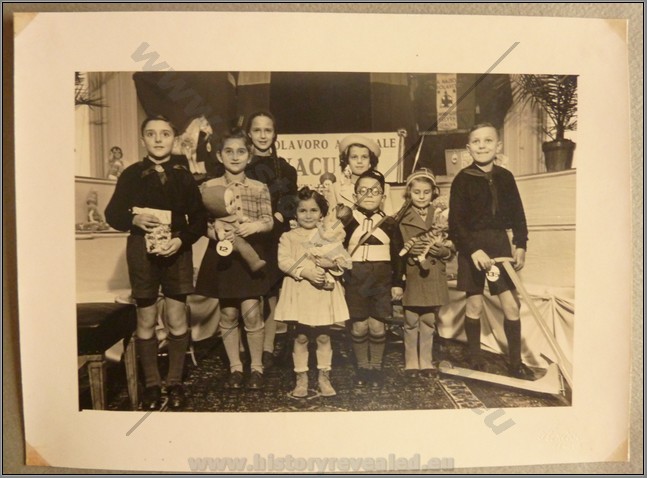
Official photo album of the now defunct Italian petroleum company, Vacuum, of Genoa. This is a record of the annual event where the company would donate gifts to the employees children. The interesting thing here is to see how fascism affected daily life. 6 professional photos. Complete. M

Price: $500.00

t-epm097bEPM 097 t-epm097cEPM 097 t-epm097dEPM 097 t-epm097eEPM 097

Copyright © 2013-2024 History Revealed